Search for Google in a brokerage app and two tickers come up: GOOG and GOOGL. Both are shares of Google's parent company, Alphabet. GOOGL is Class A stock, with one vote per share; GOOG is Class C stock, with no vote unless the law requires otherwise. Dividends are paid equally per share, and in a takeover each share receives the same consideration. The one place the two really part ways is the ballot at the shareholder meeting.
If you're buying a Google token with crypto instead, Kraken's GOOGLx and Ondo's GOOGLon are both labeled on their pages as Alphabet Class A, the GOOGL class. Kraken states that GOOGLx holders don't get the voting rights of a shareholder in the underlying stock, so that one Class A vote never reaches you. For how GOOGLon handles voting, go by what Ondo's asset page says (the page isn't available in the US and other restricted regions).
Why Alphabet has Class A, Class B and Class C shares
The description of securities (Exhibit 4.14) that Alphabet filed with the US Securities and Exchange Commission (SEC) in 2020 lists all three classes in its opening paragraph. As of that filing, they break down like this:
| Class | Votes per share | Ticker | Can retail investors buy it on an exchange? |
|---|---|---|---|
| Class A Common Stock | 1 | GOOGL | Yes, on the Nasdaq Global Select Market |
| Class B Common Stock | 10 | None | No, it isn't listed on any stock market or exchange |
| Class C Capital Stock | None, unless otherwise required by law | GOOG | Yes, on the Nasdaq Global Select Market |
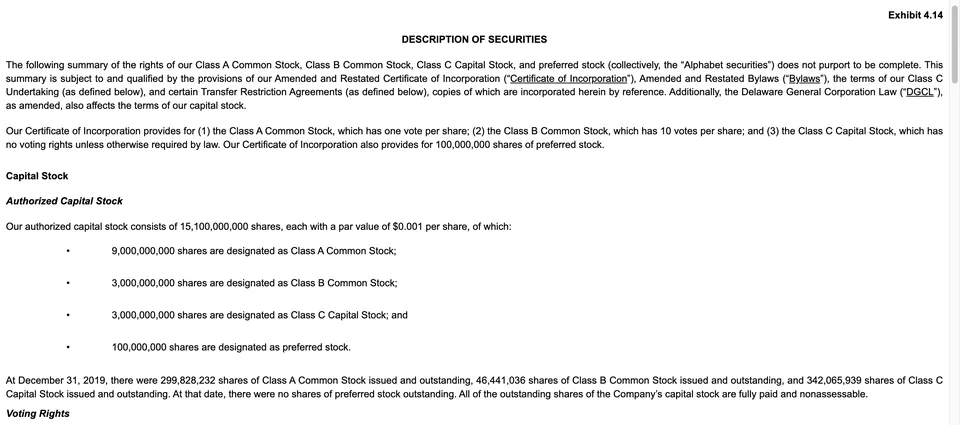
The three classes exist side by side because of voting control. The filing says Larry Page and Sergey Brin held a significant portion of the Class B shares, and through them could at the time elect all of the directors and decide most matters put to a shareholder vote. One Class B share carries as many votes as ten Class A shares, so holding most of the votes doesn't require owning most of the shares.
Class C came later. Google created it by issuing one Class C share for every Class A and Class B share outstanding as of March 27, 2014. Before that issuance there was a shareholder class action over it, settled in 2013 with the approval of the Delaware Court of Chancery. On October 2, 2015, Alphabet signed an undertaking that took on the restrictions and obligations Google had accepted in that settlement, exactly as if Alphabet were Google.
The filing also explains what Class C is for. Because Class C shares carry no vote, issuing more of them doesn't dilute the voting power of Class A and Class B holders, which could let the two founders hold on to their current share of the vote for longer.
How GOOG and GOOGL differ apart from voting rights
Read the filing's sections on dividends, liquidation, conversion and mergers side by side, and Class A and Class C are treated almost identically:
| Item | GOOGL (Class A) | GOOG (Class C) |
|---|---|---|
| Cash dividends | After any preferential rights of preferred stock, Class A, B and C share equally per share | Same |
| Dividends paid in stock | Paid in Class A shares | Paid in Class C shares |
| Liquidation | Shares equally with Class B in whatever is left after debts are paid | Each share automatically converts into one Class A share before the distribution, then shares in it |
| Merger or acquisition | Can elect the same form of consideration as Class B, with no less per share than Class B | Same amount and form of consideration per share as Class A; any choice Class A gets, it gets too |
| Stock splits and reverse splits | All three classes must be split or combined together, in the same proportion and the same way | Same |
| Conversion into another class | Not possible | Not possible, except at the moment of liquidation |
A split or reverse split of any one class has to be matched by the other two at the same time, in the same proportion and the same way, so you'll never see GOOG split while GOOGL doesn't.
For Class C, the words "no voting rights" are followed by "unless otherwise required by law," which points to exceptions under Delaware corporate law. The filing gives two cases: an amendment to the certificate of incorporation that raises or lowers the par value of a class of stock, or an amendment that would adversely affect the rights or preferences of a class. In those cases the law may require holders of that class to vote separately, and Class C holders then get a vote too.
On the other hand, simply increasing or decreasing the number of authorized shares of a class gives none of the three classes a separate vote. That is decided by Class A and Class B voting together, by a majority of the votes, and the number can't be cut below the shares already outstanding.
GOOG or GOOGL: which one should a regular investor buy?
If voting matters to you, there's only one choice: GOOGL. GOOG normally has no vote and Class B isn't listed, so Class A is the only class that gives a retail investor any say at all.
How much that say is worth can be judged against the passage from the filing cited above: as of the filing, the two founders could elect every director and decide most matters put to a vote through their Class B shares. With control set up that way, someone who owns a handful of shares, or a few dozen, has little chance of swinging a vote with GOOGL. If you don't plan to vote, GOOG and GOOGL get the same treatment on dividends, splits and takeovers.
The filing also contains a commitment that bears on the future of Class C. If the founders' combined voting power falls below 15% of the total votes of all shareholders, the board is to consider in good faith whether keeping a class of non-voting stock is still in the company's best interests, and if it decides it isn't, to take steps to convert Class C into Class A. What it commits to is considering it, not an automatic conversion once the line is crossed. The document dates from 2020; whether later annual reports changed this arrangement is something to check in the description of securities attached to Alphabet's latest annual report.
Before placing the order, check the last letter in your broker's search results: GOOGL, with the L, is Class A; GOOG, without it, is Class C. They're listed and quoted as separate stocks. Class A can't be converted into another class, and Class C can't either except in a liquidation, so if you buy the wrong one, the only fix is to sell it and buy the other.
GOOGLx and GOOGLon, the Google tokens you buy with crypto, both track Class A
Buy Google with crypto and what you get is a tokenized stock. Two tokens show their underlying share class on the issuer's or platform's public pages:
| Token | Page | Underlying stock as labeled on the page | Regional restrictions |
|---|---|---|---|
| GOOGLx | Kraken's xStocks asset page | Alphabet Inc. Class A common stock; each token backed 1:1 by a real Class A share held by a third-party custodian | Not offered in the US; only Kraken retail clients in certain countries can buy it |
| GOOGLon | Asset page in Ondo's official app | Page title reads "GOOGLon: Alphabet Class A (Ondo Tokenized)" | Ondo Stocks are not registered under the US Securities Act of 1933, are not offered in the US and are not sold to US persons; from a restricted region the page shows only an access-restricted notice |
In the Big Tech list further down Kraken's page, stock tickers and token tickers line up one to one: AAPL with AAPLx, MSFT with MSFTx, GOOGL with GOOGLx. When you come across a Google token on another platform, don't go by whether the ticker starts the same way. Open the asset page or the trading pair details and look for "Class A" or "Class C" in the full name.
If you're in mainland China, hold off on these tokens for now. The reasons, and the routes that are still open, are in How mainland investors can buy US stocks after May 22.
Why Kraken's GOOGLx doesn't give you a Class A vote
GOOGLx tracks Class A, yet the one vote a Class A shareholder holds never passes to GOOGLx holders. Kraken's GOOGLx page makes two points. Trading xStocks only gives indirect exposure to a listed company's share price and does not amount to ownership of the underlying Alphabet Class A shares: "holding tokenized equities does not convey any shareholder rights." A note at the bottom of the page adds that xStocks investors have no entitlement to the underlying shares, and no voting rights, information rights or any other rights that shareholders of the underlying stock have.
The core difference between Class A and Class C stops mattering once you're at the xStocks layer. GOOGLx tracks Class A and its holders still have no vote; Kraken's disclaimer applies to all xStocks, whatever class of share sits underneath. The class a token tracks only decides which stock your price exposure is tied to.
Why a token gets you price exposure but not shareholder status comes down to the issuer and the custody structure; bStocks vs xStocks: issuer, chain and dividends compared explains the structure both routes share. If tokenized stocks are new to you, Tokenized stock meaning: real share or just a token? is the place to start. Dividends on tokens follow a separate set of rules, covered in Do tokenized stocks pay dividends? How reinvestment and splits work.
Questions about GOOG, GOOGL and Google tokens
Where can I buy Google's Class B shares?
Class B shares aren't listed on any stock market or exchange, so you won't find them in a brokerage app. According to the description of securities Alphabet filed with the SEC, a Class B holder can convert each share into one Class A share at any time, and Class B shares convert to Class A automatically when they are transferred, except in specific cases such as transfers between the founders or for tax and estate planning. Class B shares that have been converted are not reissued.
Does GOOG pay dividends even though it has no vote?
GOOG and GOOGL get the same dividend per share. The filing says that, after any preferential rights of preferred stock, Class A, B and C shares share equally, per share, in dividends declared by the board. If a dividend is paid in stock, Class C holders receive Class C shares and Class A holders receive Class A shares.
Can GOOGLx holders vote at Google shareholder meetings?
No. GOOGLx holders have no voting rights, and no information rights or any other rights that shareholders of the underlying stock have. Each token is backed 1:1 by a Class A share held by a third-party custodian, but the one vote per share that comes with Class A never reaches the token holder. This is stated on Kraken's GOOGLx asset page.
Does GOOG get less than GOOGL if Google is acquired?
No. Each Class C share receives consideration of the same amount and form as a Class A share. In a merger or acquisition that needs shareholder approval, any choice of consideration Class A holders get, Class C holders get as well; in a liquidation, Class C shares automatically convert to Class A before the distribution. All of this comes from the description of securities Alphabet filed with the SEC.
Read next: Tokenized stock meaning: real share or just a token? · Tokenized stock issuer risk: what if the issuer fails · What is an ADR? The depositary fee on Binance stocks · bStocks vs xStocks: issuer, chain and dividends compared