The difference is what absorbs the loss. Isolated margin only uses the margin you assigned to that one position: once it’s gone, the position is liquidated and the rest of your account is untouched. Cross margin uses the whole balance of the same margin asset in your account. Liquidation sits further away, but if it does happen, what you lose could be the entire balance of your futures account.
Binance Futures uses cross margin by default. It’s easy to open a first futures position without noticing this setting and think you’re only playing with 100 USDT, when the whole balance is actually backing the trade. For a first go at futures, my advice is to switch to isolated margin first, keep the position small and the leverage low. I’ve covered whether a liquidation can leave you owing money, and what’s left afterward, in Can You Owe Money After a Futures Liquidation?
The difference is how big the margin pool is
Opening a futures position means putting up margin. Isolated margin sets aside a separate chunk for each position. When that chunk is used up, that position is liquidated, and your other positions and your account balance aren’t affected. Cross margin puts the balance into one pool that every cross position shares.
Binance’s help article on switching between cross and isolated margin describes cross margin more precisely: cross margin mode shares your margin balance across all open positions on the same type of asset. Its example is that if you pick cross margin on the BTCUSD perpetual, the positions on that contract share only the BTC margin balance. So “the whole balance” means the balance of that one margin asset, not every coin you hold added together.
Binance’s margin trading (borrowing to buy or sell) also comes in these two modes. Another help center article, on the difference between isolated and cross margin, puts it like this: isolated margin is kept separate for each trading pair, so a liquidation on one pair doesn’t affect the others, while cross margin uses the whole account balance as collateral, so the risk is linked.
| Isolated | Cross | |
|---|---|---|
| Money this position can draw on | The margin assigned to it when opened | The account balance in the same margin asset |
| Most you can lose on liquidation | That position’s margin | Possibly the whole balance |
| Between several positions | Each one is counted separately | They share the balance and affect each other |
| Binance Futures default | No | Yes |
Working it through with 1,000 USDT (illustrative)
The rough math in this section ignores maintenance margin, fees and funding rates. The real liquidation price is the estimated one shown when you place the order. The rough math uses just one relationship: loss = notional value × percentage the price drops.
Setup: 1,000 USDT in the account, one BTC long with a notional value of 1,000 USDT at 10x leverage, so the margin used = 1,000 ÷ 10 = 100 USDT.
Isolated
The only money this position can absorb losses with is that 100 USDT. The drop needed to lose all 100 USDT = 100 ÷ 1,000 = 10%. If BTC falls about 10%, the position is liquidated and you lose 100 USDT; the other 900 USDT in the account isn’t affected.
Cross
All 1,000 USDT can go toward covering this loss. The account’s real leverage is now notional value ÷ account balance = 1,000 ÷ 1,000 = 1x. By the same rough math, losing the whole 1,000 USDT would take a drop of 1,000 ÷ 1,000 = 100%. Once maintenance margin is counted, the real liquidation comes earlier than that, but it’s still far further away than the 10% under isolated margin.
| Isolated | Cross | |
|---|---|---|
| Money that can absorb losses | 100 USDT | 1,000 USDT |
| Rough distance to liquidation | About a 10% drop | Well beyond 10% (close to 100% by the rough math) |
| Lost on liquidation | 100 USDT | Possibly all 1,000 USDT |
After that table, it’s easy to conclude that cross margin is safer. In fact, what lets cross margin hold out is the account’s low real leverage, not the cross mode itself. Stay in cross mode but open a position with a notional value of 10,000 USDT, and the account’s real leverage becomes 10,000 ÷ 1,000 = 10x. By the rough math, a drop of 1,000 ÷ 10,000 = about 10% and the entire balance is gone.
How maintenance margin brings liquidation forward, and how to work out the liquidation price at different leverage, is broken down in How to Calculate Liquidation Price, With Examples.
Two positions on cross margin drag each other down
With a single position, you can’t see the other side of cross margin yet. Say you hold two positions at once in cross mode, both using USDT as margin. They draw on the same balance, so the more one of them loses, the less is left in the pool, and the closer the other position’s liquidation price is pushed. If the market moves a bit further against you, the position that was perfectly fine can get liquidated along with it.
Isolated margin doesn’t behave like this; each position only looks at its own margin. Flip that around and you have the reason some people use cross margin on purpose. If the two positions hedge each other, one gains while the other loses, the profit and loss are counted in the same balance, and a one-sided liquidation is less likely. That only holds if you know how much weight each position carries in the account.
How to switch on Binance, and when you can’t
- Open the futures trading screen and tap [Cross] at the top right.
- In the confirmation screen that pops up, choose the margin mode and tap [Confirm].
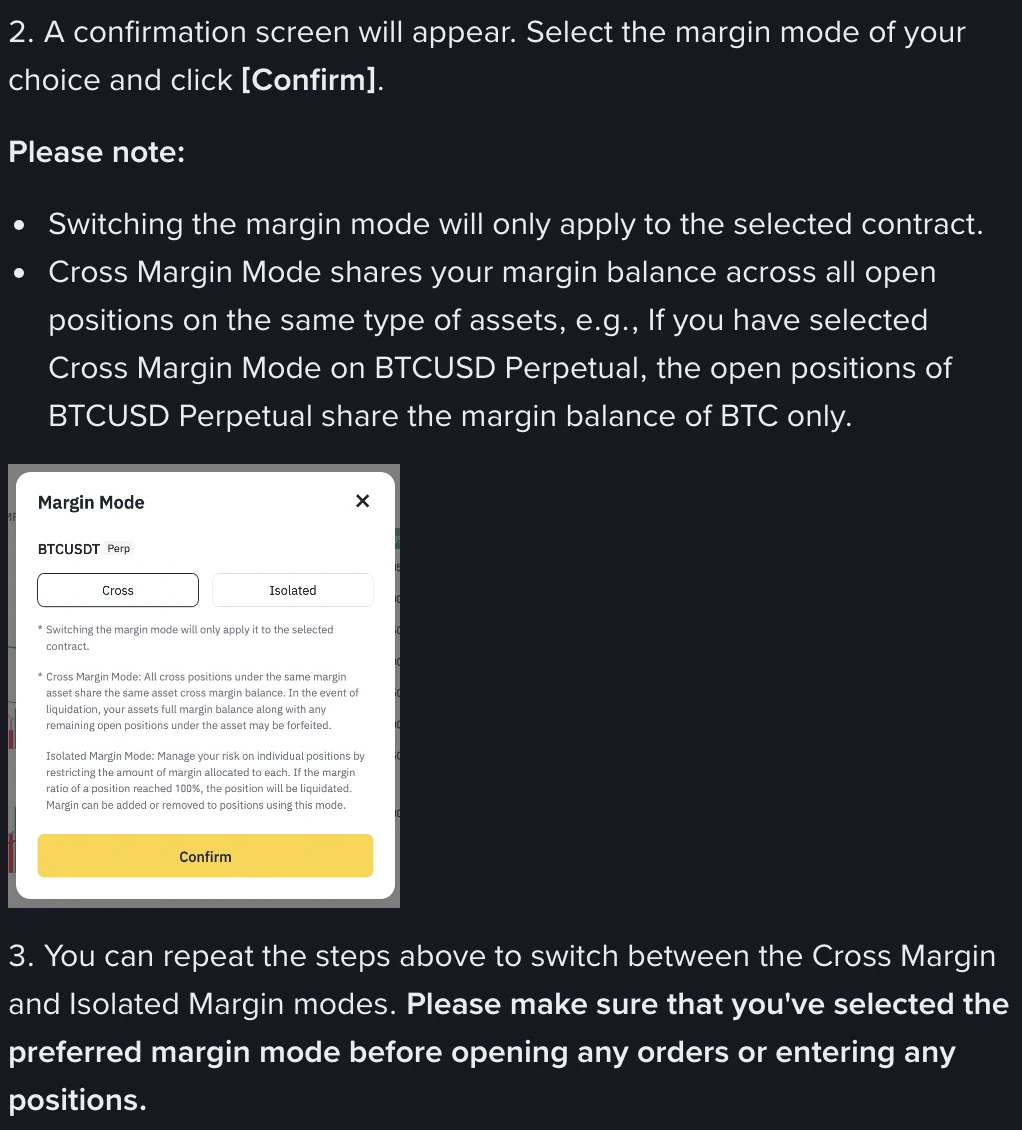
The same help page lists a few more rules, and beginners tend to get stuck on the second one:
- All contracts and positions use cross margin by default.
- You can’t switch margin mode while you have open orders or positions. To switch, cancel the open orders on that contract and close the position first.
- The switch only applies to the selected contract. Switch BTCUSDT to isolated, move to a contract you haven’t touched yet, and it’s still on the default cross margin, so you have to switch it again.
Also, futures aren’t available everywhere. Binance, for example, restricts derivatives for users in Hong Kong, covering futures, options, leveraged products and leveraged tokens. Check whether you can use them where you live before you open anything.
Which one should a beginner use first?
For a first go at futures, I’d use isolated margin, with a small position and low leverage. Isolated margin limits the worst outcome to that one position’s margin, so even if you get the liquidation price wrong, that position is all you lose. One thing to watch is that isolated margin lets you add margin to the position manually, and however much you add is how much more you can lose in the worst case.
Cross margin suits two kinds of people better: those who know how much overall risk their account carries, and those who already hold hedging positions. If you can’t yet say what your account’s real leverage is, leave cross margin alone for now.
Whichever mode you use, look at the estimated liquidation price before placing the order, and set your stop so it triggers well before the liquidation price. For how to set the stop, see Risk-Reward Ratio: How to Calculate It, What’s Good; for why leverage itself is dangerous, What is Leverage? Why most new traders die here goes into more detail.
Other questions you might have
Which gets liquidated more easily, cross or isolated margin?
That depends on your account’s real leverage, not on the mode. Take the same 10x position: isolated margin only has the margin assigned to it to absorb losses, so a short move against you gets it liquidated. Cross margin draws on the whole balance, and while your account’s real leverage is low, liquidation sits further away. But if a cross position is 10 times your balance, a drop of around 10% wipes out the entire balance.
Is Binance Futures cross or isolated margin by default?
Binance’s help center states that all contracts and positions use cross margin by default. To change it, tap Cross at the top right of the futures trading screen, pick the mode and tap Confirm. The switch only applies to the contract you selected.
Why can’t I switch my margin mode?
Binance does not let you switch margin mode while you have open orders or an open position. Cancel the open orders on that contract and close the position first, then switch.
Which should a beginner pick for a first futures trade?
My suggestion is isolated margin, a small position and low leverage. Isolated margin caps the worst case at that one position’s margin, so if you get something wrong, that position is all you lose; if you have added margin to it, the worst case grows by the amount you added. Cross margin suits people who know their account’s overall risk, or who already hold hedging positions.