Usually, no. On Binance USDⓈ-M futures, under normal circumstances your loss is capped at the margin that position can draw on. If the market moves so fast that the loss runs past the margin, that extra slice is covered by the futures insurance fund, within what the fund holds, and nobody comes to you for it.
If your account briefly shows a negative balance in the system, Binance runs an automatic reset every ten minutes that brings eligible accounts’ negative balances back to zero. But plenty of people read “capped at the margin” too narrowly. In cross margin mode, the margin is the whole balance of the same margin asset in your futures account, and a liquidation also comes with a liquidation clearance fee. So after a liquidation you won’t owe anything, but what’s left is often less than you expected.
Everything below describes Binance’s rules. Other exchanges each handle liquidations and negative balances their own way; before using another platform, read its liquidation rules page first.
“Capped at the margin”: which margin?
That depends on whether you opened the position on isolated or cross margin.
- Isolated: you can lose at most the margin assigned to that position. Any margin you added manually along the way counts too. The rest of your account isn’t affected.
- Cross: the whole balance of the same margin asset is backing that position. Liquidation sits further away, but once it happens, you could lose the entire balance of that asset in your futures account.
Binance Futures is on cross margin by default. If you’ve never switched modes, your whole futures balance is backing the position. I worked through both modes, and where to switch, with 1,000 USDT in Cross or Isolated Margin? What Beginners Should Pick.
When the loss goes past the margin, who fills the hole?
First, the bankruptcy price. That’s the price at which the position’s loss has used up exactly all of its margin. Normally liquidation is triggered before the price gets to the bankruptcy price, and the system closes the position. Going past it is a different situation, where the market moves so fast that by the time the position is closed, the price is already beyond the bankruptcy price and the loss is bigger than the margin.
Binance’s help center page on its futures liquidation protocols (updated 2026-01-04) sets out how this is handled, in a few layers:
- A position that has gone past its bankruptcy price is closed at the bankruptcy price, and the loss beyond the margin is covered by the futures insurance fund to the extent the fund can cover it.
- If the insurance fund can’t cover it, auto-deleveraging (ADL) kicks in. Following set rules, the system reduces some profitable positions on the other side to offset the loss.
- Every ten minutes the platform automatically resets eligible accounts’ negative balances to zero, so an account doesn’t stay negative.
So the part beyond the margin doesn’t land on the trader whose position blew through it. When the insurance fund can’t absorb it, it can land on the people on the other side who are making money. If one day you’re holding a profitable position and part of it gets reduced automatically, that isn’t a system error.
If you don’t owe anything, why is so little left?
It’s common to open the account after a liquidation and find less left than you had worked out. The reason is usually one of the two below.
Liquidation comes before the margin hits zero
A position has to keep enough maintenance margin. Once losses bring the margin down to the maintenance margin line, liquidation is triggered; it doesn’t wait for the margin to reach 0. How maintenance margin pulls the liquidation price closer is covered with formulas and examples in How to Calculate Liquidation Price, With Examples.
The liquidation clearance fee is charged on notional value
The same help center page states that a liquidated position is charged a liquidation clearance fee, calculated as:
It’s multiplied by the notional value, not by the margin you put up. An illustrative example: with the same 100 USDT of margin, 10x leverage gives a notional value of 1,000 USDT and 20x gives 2,000 USDT. At the same fee rate, the 20x position pays roughly twice the clearance fee of the 10x one when it’s liquidated (the fee is based on notional value at the moment of liquidation). The higher the leverage, the bigger the share of your margin this fee takes.
So when you estimate how much will be left after a liquidation, don’t just take “margin minus the loss you expect.” Liquidation happens at the maintenance margin line, and this fee comes off after it’s triggered.
The candles never touched the liquidation price, but the position is gone
This is where beginners often can’t work out why they were liquidated. The reason is that liquidation doesn’t watch the candles you’re staring at.
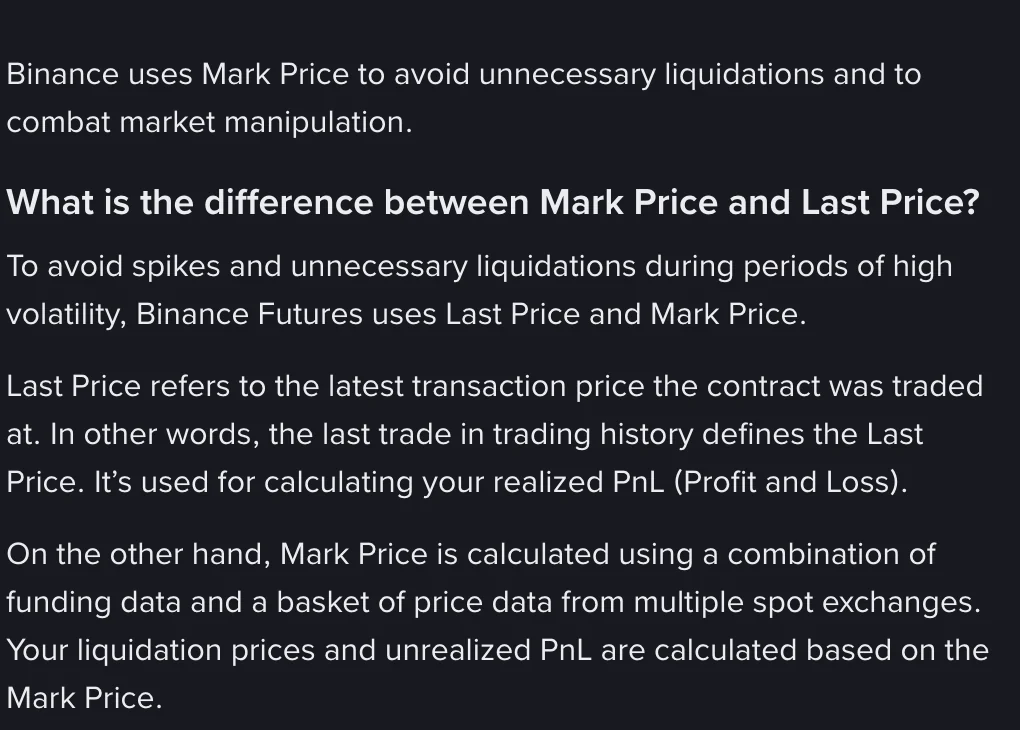
The same liquidation protocols page separates the two prices. The last price is the most recent price the contract traded at and is used to calculate realized PnL. The mark price is calculated from funding data and a basket of prices from several spot exchanges, and both your liquidation price and your unrealized PnL are calculated from the mark price. Binance says it uses the mark price to avoid unnecessary liquidations and to counter market manipulation.
How the mark price is calculated is set out in a separate help article, an introduction to mark price and price index for USDⓈ-M futures:
Price 2 = price index + 30-second moving average of the basis
Price index = weighted average of prices on several major spot exchanges
You don’t need to be able to calculate this. It’s enough to know that the mark price isn’t the last traded price. That has two consequences:
- The last price wicks through your liquidation price, but the mark price doesn’t follow it there, so the position isn’t liquidated.
- The other way round, if the mark price reaches your liquidation price, the position is liquidated, even if the candles on your chart are still a little short of it.
The help center also notes that the app and the website let you switch the chart between the two prices. With a futures position open, switch to the mark price and compare it against the liquidation price.
What to check before opening a position
- Margin mode: isolated or cross. The default is cross; if you only want to risk one specific amount, switch to isolated first.
- Estimated liquidation price: it’s shown on the order screen. Set your stop so it triggers well before the liquidation price, and the position never gets as far as liquidation.
- Notional value: the clearance fee is charged on it. Raise the leverage and the notional value grows with it, so more is taken if you’re liquidated.
- Whether your region allows it: futures aren’t offered everywhere; Hong Kong users, for example, can’t use Binance’s derivatives.
Liquidation questions
Can you end up owing the exchange money after a futures liquidation?
On Binance USDⓈ-M futures, not under normal circumstances. A position whose loss has gone past its margin is closed at the bankruptcy price, the loss beyond the margin is covered by the futures insurance fund as long as the fund has enough, and the platform automatically resets eligible accounts’ negative balances to zero every ten minutes. Other exchanges have different rules, so read their liquidation rules page before you use them.
What happens if the insurance fund isn’t enough?
Binance’s rule is to trigger auto-deleveraging (ADL): following set rules, some profitable positions on the other side are reduced to cover the loss. So in an extreme market, even a position that is making money can be partly reduced.
The chart never reached my liquidation price. Why was I liquidated?
Binance calculates liquidation prices from the mark price, not the last traded price. The mark price draws on a basket of prices from several spot exchanges, so it can differ from the candles you are looking at. If the mark price reaches your liquidation price, the position is liquidated; the other way round, if the last price wicks through but the mark price does not get there, it is not.
Can an isolated margin liquidation take the rest of my account with it?
No. Isolated margin can lose at most the margin assigned to that position, including any margin you added manually. Cross margin is different: the whole balance of the same margin asset backs the position, so a liquidation could cost you the entire balance.