Open Apple on Binance Stocks, then open TSM, and you get the same page layout. What you end up holding with TSM, though, is a depositary receipt: there is an extra ADR tag next to the ticker, one unit does not necessarily equal one underlying share, and holding it can trigger a charge you never placed an order for.
That small tag next to the ticker is the easiest clue on the page
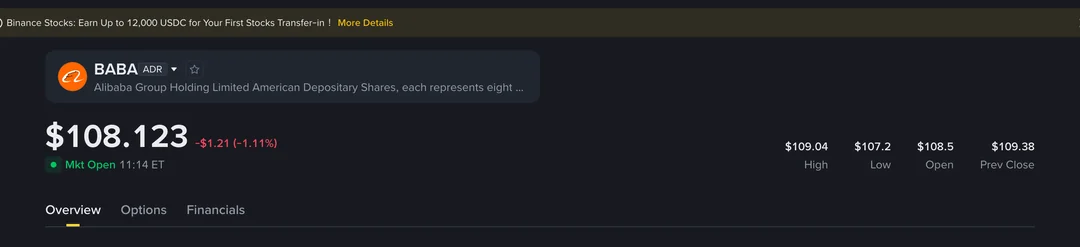
In September 2026 I read through three public stock pages (the market pages you can open without logging in), and the difference sits right there in the title line.
| Stock page | Name as shown on the page | Next to the ticker |
|---|---|---|
| AAPL | Apple Inc. Common Stock | No ADR tag |
| TSM | Taiwan Semiconductor Manufacturing Company Ltd. (TSM) | ADR tag; no ratio in the title |
| BABA | Alibaba Group Holding Limited American Depositary Shares, each represents eight Ordinary Shares | ADR tag; ratio written right into the name |
All three pages use the same template, and the tag beside the ticker is what separates them at a glance. So don't just scan the ticker; read the name line to the end as well. BABA puts the ratio into its full company name; TSM's line doesn't.
How many ADRs Binance lists, and whether every one of them carries the tag, is something you'd have to check yourself. If a non-US company shows no tag next to its ticker, look in the name for the words American Depositary.
An ADR is a receipt issued by a depositary bank
The SEC Office of Investor Education and Advocacy defines it this way in its 2012 investor bulletin on ADRs: shares of a non-US company are held by a US depositary bank (or by its custodian in the home market), and the bank issues receipts in the US against those shares. That receipt is the ADR. It trades in US dollars and settles through US systems, so you don't need to deal in the company's home currency or place an order on its home market.
ADR and ADS are often used interchangeably; strictly speaking, the ADS is the security and the ADR is the receipt that evidences it. BABA's page says American Depositary Shares, and it refers to the same kind of instrument.
The receipt works in both directions. The company itself, or investors holding the ordinary shares, can deliver those shares to the depositary bank or its custodian and have ADRs issued; going the other way, holders can hand ADRs back and receive the underlying shares. The bulletin notes this step is usually carried out by brokers and other active market participants.
The bulletin also sorts ADRs into types. Sponsored ADRs are set up by the company signing an agreement with the depositary; unsponsored ADRs have no company involvement and can be initiated by a broker. Level 1 can only trade over the counter and can be unsponsored, Level 2 can list on an exchange and requires the company to file a 20-F, and Level 3 also lets the company raise capital through the program.
One more point that matters if you follow earnings: disclosure rules for non-US companies are not the same as for US companies. Beyond the 20-F, they generally disclose only under their home-country rules. Don't expect their numbers on the schedule you're used to from US companies.
One ADR is not one ordinary share
The ratio is where people most often trip up. Per the SEC bulletin, one ADR can represent a single share, a fraction of a share, or several shares, and it is designed that way to bring the price into a range typical for US stocks.
BABA puts the answer right on the page: the phrase each represents eight Ordinary Shares in its name means one depositary share stands for eight ordinary shares. Buy 100 units and that corresponds to 800 underlying shares. Before comparing per-share figures calculated on an ordinary-share basis with the ADR price, you at least need to multiply them by that ratio.
TSM's title has no such phrase, so you'll need to look up its ratio separately.
The extra charge: the depositary fee
This is where an ADR and an ordinary share genuinely differ on your statement. On the Binance Stocks fee page (viewed September 2026), the American Depository Receipts (ADRs) row in the Others section reads $0.01 to $0.03 / per Share, and the description column says Pass-through fees.

Look at the word pass-through: the fee page is labeling this as a charge collected further up the chain and handed on to you unchanged. Who collects it? The SEC bulletin says the depositary bank, under the custody fee in the deposit agreement (also called Depositary Services Fees), to cover costs such as custody, registration, compliance, dividend distribution, shareholder communications and recordkeeping. As for scale, the bulletin says the fee is usually charged per ADR, and for 1,000 ADRs it might come to between $20 and $50.
The bulletin describes two ways it reaches you. For ADRs that pay dividends, the common practice is to deduct it from the gross dividend, and DTC publishes both the gross dividend rate and the net rate after the fee. For ADRs that don't pay dividends, DTC charges its participants (banks and brokers), which then pass the cost on to their customers.
For timing and rounding, you have to go to the API documentation of Alpaca, the clearing and custody firm (the page says Updated 2 months ago; viewed September 2026):
- according to the documentation, most ADRs carry a fee of $0.01 to $0.03 per share, charged once or twice a year; the actual amount depends on how the depositary bank runs the program, and it can be lower;
- customers are generally charged monthly, after the depositary has charged Alpaca, and the record date on the charge is usually in the month before the one in which it is actually deducted;
- if you hold on the record date, you pay, even if you have sold the shares since;
- rounding: amounts under one cent are not charged, and anything above one cent is rounded up to the next whole cent. The documentation's example is $0.02 per share on 10.1 shares, which comes to $0.21.
Those timing and rounding rules come from Alpaca. The Binance fee page only gives the $0.01 to $0.03 range; it doesn't say when the fee is taken or how it is rounded, or that Binance applies Alpaca's rules as they are. To reconcile, find that charge in your account's fee records.
A round-number example: at $0.02 per unit on 500 units, and at the once-or-twice-a-year frequency in Alpaca's documentation, that is $10 a year if charged once and $20 if charged twice. (The fee page says per Share; the SEC bulletin's example is per ADR.)
To find the exact fee for a particular ADR, the SEC bulletin points you to its Form F-6 on EDGAR, usually in the section titled “Description of American Depositary Shares/Receipts.”
Don't confuse this with the fee you pay to trade. That one is the platform fee, with its tiers in the Platform Fee section of the fee page (a promotion was running in September 2026, ending September 30). No order, no platform fee. The depositary fee is different: holding alone can trigger it. I pay more attention to this kind of charge than to trading fees. A trading fee is right in front of you the moment you place the order; this one doesn't show up at that moment, and the longer you hold, the easier it is to forget.
A few more rows on the fee page, and they apply to Apple as much as to ADRs
Except for the first row, everything here applies to ordinary shares too. The dividend and withholding tax rows sit in the Dividends & Taxes section of the fee page.
| Item | What the fee page says (2026-09) |
|---|---|
| ADR depositary fee | $0.01 to $0.03 per share, labeled Pass-through fees |
| Mandatory corporate actions (splits, mergers, etc.) | $0.00, processed automatically |
| Voluntary corporate action (VCA) | $200 for each unique election |
| Securities transfer out (DTC Transfer, outbound) | $150 per security, per submission; ACATS not supported |
| Dividend processing | $0.00 |
| US withholding tax (default) | May apply; defaults to 30% of the gross dividend, withheld by the clearing firm before crediting |
| SEC / FINRA / CAT regulatory fees | Fee page says Binance covers them |
The $200 for voluntary corporate actions deserves its own note. The fee page says Per unique election: for a corporate event that requires you to submit a choice yourself, you're charged $200 for each separate election. Unlike the depositary fee, it doesn't arise unless you submit an election.
The transfer-out row works the same way. The fee page says ACATS isn't supported, so moving holdings out goes through DTC Transfer at $150 per security per submission; move several stocks and you pay for each one. That is worth knowing before you decide to buy a little just to try it out.
Why dividends come in lower than your estimate: the depositary fee, and a withholding tax line that covers every stock
The depositary fee first. The common method in the SEC bulletin is deduction from the gross dividend, and the net dividend rate DTC publishes is the figure after that deduction. Alpaca, the clearing and custody firm, says in its own documentation that the depositary charges Alpaca first and Alpaca then charges customers, usually monthly. So the fee may reduce the dividend you receive, or it may show up as a separate entry in your account. The SEC bulletin also mentions that depositary banks may charge additional fees for things like dividend distribution, currency conversion and voting.
Then withholding tax. The Dividends & Taxes section of the Binance fee page says Binance charges $0.00 for processing dividends, US withholding tax may apply with a default of 30% of the gross dividend, withheld by the clearing firm before it is credited, and that this is not a Binance fee.
That line applies across the entire US stock fee schedule; it was not written specifically for ADRs. For the rate actually withheld on an ADR dividend, check your own withholding records and tax documents, and don't assume the depositary fee has already been taken out of the dividend either.
So if you estimate what you'll receive as dividend yield times position value, the number may come out too high. When I estimate ADR dividends I'd rather err on the low side, then check it against the deduction records once the payment arrives.
One more thing: the fee page says default 30%, and the operative word is default. Whether a treaty rate applies or you need to file a form, don't treat the default as the answer; look it up against your own tax status. Also keep in mind that an ADR stands for shares of a non-US company, and many issuers' home countries withhold tax on the dividend under their own rules before it reaches the depositary; the fee page doesn't cover that layer, so check the issuer's announcements and the deposit agreement.
Where these rules stop
The fee page has a scope statement at the bottom: the schedule applies only to Direct Equities, meaning US stocks and ETFs, and tokenized stocks and other products follow separate fee schedules.
None of the fees above carry over to tokenized stocks. How dividends and splits reach holders on the tokenized side follows a different set of rules altogether.
The same page adds another layer: the stock trading service is provided by Nest Exchange Limited, clearing and custody are handled by Alpaca Securities LLC (member FINRA/SIPC), and the service is only available to eligible users in supported jurisdictions. Who holds your US stock positions, and whether the service is offered where you live, are separate matters from the crypto account in the same app.
My own habit is to read the name line to the end before tapping buy. If the stock carries the ADR tag, I convert the share count using the ratio in the name and check the depositary fee against that row in the Others section of the fee page.
A few questions you'll run into
How can I tell quickly whether a stock page is for an ADR?
Check two places: whether there is an ADR tag next to the ticker, and whether the full company name contains the words American Depositary along with a ratio. When I checked in September 2026, BABA's name read “Alibaba Group Holding Limited American Depositary Shares, each represents eight Ordinary Shares” and Apple's read “Apple Inc. Common Stock.”
Is the depositary fee charged by Binance?
No. The Binance Stocks fee page (viewed September 2026) lists it in the Others section at $0.01 to $0.03 / per Share, with Pass-through fees in the description column, meaning it is collected upstream and passed on unchanged. According to the SEC Office of Investor Education and Advocacy's 2012 investor bulletin on ADRs, the fee is collected by the depositary bank under the custody fee in the deposit agreement (also called Depositary Services Fees).
I've already sold the stock. Can I still be charged the depositary fee?
The API documentation of Alpaca, the clearing and custody firm, says that if you held the ADR on the record date, you still owe the fee even if you have sold since. That rule comes from Alpaca's own documentation; the Binance fee page only lists the fee range. To see whether it was actually charged, look for it in your account's fee records.
Why is my dividend lower than I calculated?
Three layers may be involved. The first is the depositary fee: the common method in the SEC bulletin is to deduct it from the gross dividend, while in Alpaca's documentation the depositary charges Alpaca first and Alpaca then charges customers, usually monthly, so it may reduce the dividend or appear as a separate entry. The second is the issuer's home country: many withhold tax on the dividend under their own rules before it reaches the depositary, and the fee page doesn't cover that layer. The third is the US withholding tax line on the fee page that covers all stocks: it may apply, defaults to 30% of the gross dividend, and is withheld by the clearing firm before crediting. Binance itself charges $0.00 for dividend processing.
Do these rules apply to tokenized stocks too?
No. The Binance Stocks fee page states at the bottom that the schedule applies only to Direct Equities, meaning US stocks and ETFs; tokenized stocks and other products have separate fee schedules. So the fees in this article can't simply be applied to tokenized stocks. Check the schedule that covers them instead.