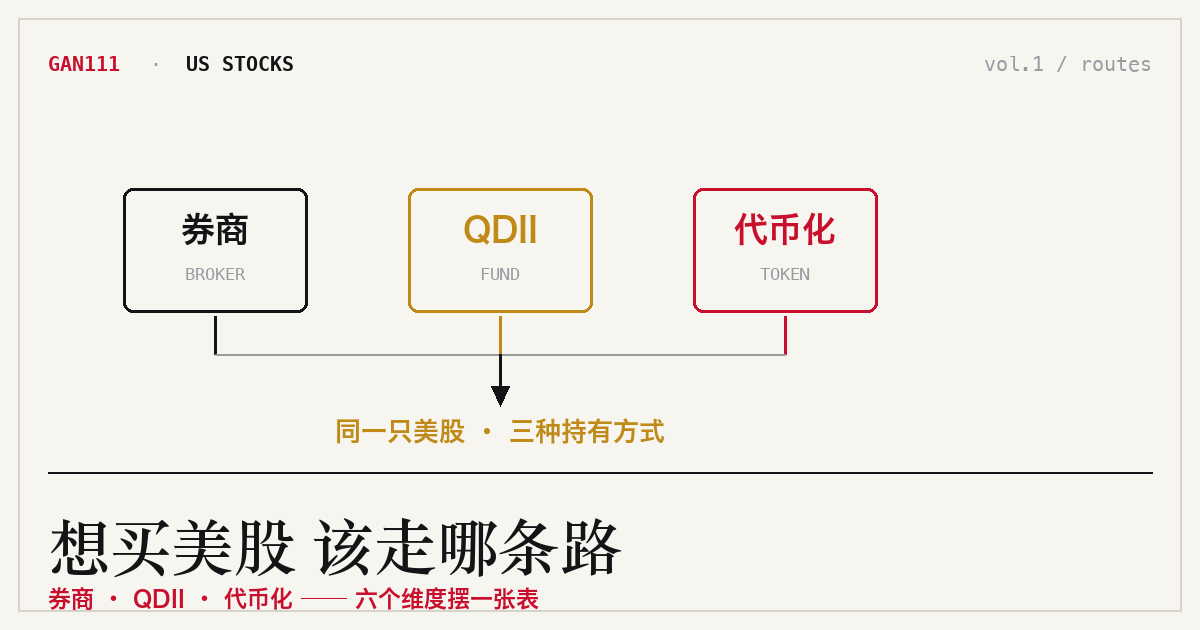
Underneath the sentence “I want to buy some US stocks” sit three roads that lead to very different places: open a brokerage account with direct access to the US market, buy the exposure through a regulated fund on a market where you already have an account, or spend stablecoins on a tokenized share. What it takes to get in, what you can actually buy, and who is standing behind you when something breaks are not remotely the same across the three. Pick the road first; the mechanics only matter afterwards. Do it in the other order and you end up an hour deep in how a token issuer calculates its dividend multiplier, when what you actually needed was a brokerage account. For readers in mainland China there is one more layer: since the CSRC's press Q&A of 22 May 2026, which of these roads is still open looks completely different, and this piece goes through them again under the new rules.
The short answer: which one are you
Start with where you are. In mainland China: overseas brokers can no longer open an account for you, the tokenized route is restricted under Yinfa [2026] No. 42, and the compliant options are QDII funds and cross-border ETFs, Wealth Management Connect, and Stock Connect (which only reaches Hong Kong) — US exposure from there means a basket, not one named company. Outside the mainland, where local rules allow: if you want to own the real share, want shareholder status, plan to hold for years, and are willing to sit through onboarding and the cost of moving money around — take the broker route. If you only want a slice of the US market inside an account you already have, and you genuinely do not mind that you cannot buy one specific company — take the regulated fund route. If all you hold is stablecoins, the amount is small, you want to feel the thing work before committing anything real, or you want to be able to react while the US market is shut — take tokenization, but be clear that what sits in your account is a token the issuer created, not the share itself.
None of the three is better in the abstract; what matters is whether it matches what you need. Two mismatches to avoid: grinding through a full cross-border brokerage onboarding with pocket-money amounts, and putting the whole position into tokens when you intend to hold for ten years. What follows is each route on its own terms.
Route A · A broker with direct access to the US market
The orthodox one. You are a named client of the broker, what you hold is the actual share, dividends land as cash, you get voting rights, and corporate actions run on rules the securities market has been running for decades. The price is that all of the friction is front-loaded, stacked up before you have made a single cent.
The biggest change is for readers in mainland China. On 22 May 2026 the CSRC answered press questions on its plan to clean up illegal cross-border securities, futures and fund business, and the position is plain: overseas institutions may not open new accounts for mainland investors; existing clients get a two-year rectification period during which only sell orders and transfers of funds out are allowed; after that, service stops. So from the mainland this route can no longer be started from scratch, and anyone with an existing account is down to selling and moving the money out. (CSRC Q&A on its official site, checked 2026-09.)
What follows about onboarding and funding is for readers outside the mainland whose local rules allow it. Opening the account takes three things: proof of identity, proof of address, and a declaration of your tax status (non-US persons are usually asked to certify that they are not US taxpayers). None of it is difficult. What makes it slow is being sent back for a document you did not have ready. The thing to settle before any of that is access: whether people resident where you live can open with the broker you have in mind at all, and which brokers will take you. That is set by your jurisdiction and by the broker, it moves, and it is not something to copy out of any article, including this one — my read here is 2026-09 and it is a description of the mechanism, not of your eligibility.
Funding usually means a wire or a local transfer, and somewhere in the chain a currency conversion. Here is the arithmetic people skip: transfer fees and the FX spread behave like fixed costs, so the smaller the amount, the worse the percentage looks. On a position of any size it rounds away to nothing. On pocket money you can lose a visible slice just going in and coming back out again.
What you can buy is this route's real advantage: single names, ETFs, options, effectively the whole market. Of the three routes, only this one lets you buy precisely that one thing you had in mind.
Trading hours are the US regular session, with many brokers also offering pre-market and after-hours. The rules are published and unambiguous. Whether they are friendly to your sleep is entirely a function of your time zone, and it is worth checking that before you commit to a route you intend to trade actively.
Dividends arrive as real cash in the account. But US-source dividends paid to a holder outside the US are generally withheld at source, and how much comes off depends on your tax residence and on whether there is a treaty between it and the US and what that treaty says. I am not putting a number on it: it is specific to you and it changes. The same goes in the other direction — reporting a foreign investment account to your own tax authority is an obligation that belongs to you, not to the broker, and it is the part people discover late.
Who is standing behind it: the investor-protection scheme of whatever jurisdiction the broker is licensed in. Read carefully what those schemes actually cover. They cover the broker failing and your assets going missing with it. They do not cover your position falling. Those two things get conflated constantly, usually by people quoting a coverage figure at each other.
If you are in the mainland and already hold an overseas brokerage account, ignore anyone telling you that you can keep buying or reopen with a different set of documents: under the CSRC's position you may only sell and move the money out during the rectification period, and service ends after it. This site does not publish workarounds.
Route B · The regulated route where you already are (QDII, from the mainland)
This is the easy one to start, mostly because there is nothing to start: you use a broker licensed in your own country, or you buy a fund or an ETF listed on your own market. No overseas onboarding, no forms in a second language, funding in the currency you are already paid in. What you give up is reach — the menu is shorter, and you react a beat later than the market you are tracking.
For readers in mainland China, the CSRC's 22 May Q&A names the compliant channels outright: Stock Connect, QDII and Cross-boundary Wealth Management Connect. Southbound Stock Connect reaches securities listed in Hong Kong, not in the US; the southbound leg of Wealth Management Connect covers funds and similar products, not individual US stocks, with eligibility, product range and quotas set by the current rules. In practice, US exposure from the mainland means a QDII fund or a cross-border ETF — a basket, not a named company.
Before you file this route under traditional and stop reading the paperwork, check what the product on your screen actually is. A local platform can display a US ticker without giving you the share behind it. Some route you into a contract that only tracks the price. Some hold a fractional entitlement in the firm's own name and pass the economics through to you. All of those can be entirely legitimate and properly regulated, and none of them except outright share ownership puts you on the register. The product page and the client agreement tell you which one you are buying; the ticker on the screen does not. It is quick to check, and it decides whether this route is really the orthodox one for you or a differently packaged version of route C.
The other half of this route is the fund wrapper: a fund or an exchange-traded fund listed where you already trade, holding US assets on your behalf. A licensed manager buys, an independent custodian holds, disclosure runs on a published schedule, and you buy a share of the pool in your own currency during your own market hours. Structurally it is the most complete of the three. The trade-offs are all consequences of the wrapper itself:
- You are buying a basket. The overwhelming majority of these track an index or a theme. If your goal is one specific company, this route is simply out.
- The wrapper can trade away from what it holds. A listed fund is priced by supply and demand on your exchange, and when the creation and redemption machinery is congested or capacity-constrained, the price can sit visibly above the value of the assets inside. Buying at a premium is paying a cost that never appears on a fee schedule. The same mechanism, in a different wrapper, is what makes tokenized share prices drift from the real share.
- It reacts late by design. US prices move while your market is closed; you act on your next local trading day, and subscriptions and redemptions settle slower than you would like. This is a route built for allocation, not for reacting to news.
- Minimums and suitability vary. Minimum investment, appropriateness or suitability checks, and whether your account is even permitted to hold a particular product differ by product and by where you live. The fund documents and your own regulator's current rules are the source. Nothing in an article can be.
On the question of who is standing behind it, this route is the strongest of the three: a licensed manager, assets held by an independent custodian, and disclosure you can go and read. That is not a guarantee against losing money. It is a guarantee that there is an institution and a rulebook between you and the assets.
Route C · Tokenized US stocks: the lowest bar, and a shadow of the share
The bar here is barely a bar: an account, a little stablecoin, and a few minutes gets you price exposure to a US name, in sizes small enough that no broker would want the paperwork. The price is an extra layer of issuer risk, and the fact that, strictly speaking, what you are holding is not a share.
For mainland China residents, this route comes with a large caveat. The PBoC-led notice Yinfa [2026] No. 42 states that overseas entities and individuals may not illegally provide virtual-currency-related services to domestic parties in any form, and bars providing real-world-asset tokenization services to them — tokenized US stocks sit squarely inside that. The tokenized-stock articles on this site are written for readers outside the mainland (overseas, Hong Kong, Macau, Taiwan); if you are in the mainland, treat this route as background reading. This site does not offer, and will not describe, any way around those rules.
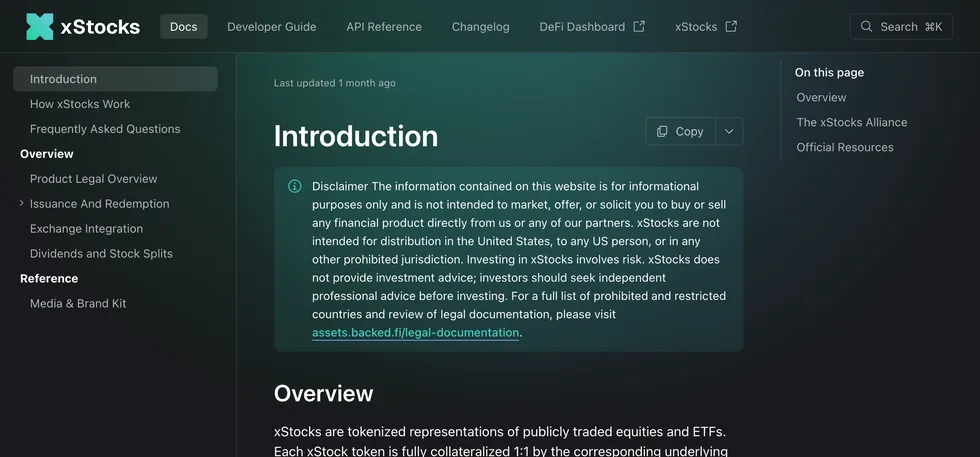
What you actually bought: the issuer buys and custodies the matching real shares in the background, then mints tokens against them in proportion and sells you one. You get price exposure. You do not get shareholder status and you do not get a vote. The product documents say so directly, and the explainer on what a tokenized stock is takes the structure apart properly.
Small sizes and fractions are where this route genuinely wins. At the amounts it handles comfortably, a broker's transfer cost alone would make the trade pointless, and the piece on minimums and fractional buys does that arithmetic. Trading hours are nominally around the clock, but weekends and US market closures are thin books where prices distort easily, which is the whole subject of the trading-hours piece.
Dividends do not arrive as cash. The issuer applies a multiplier to reflect distributions and splits in your balance, with nothing for you to do, and the rules for that live in the issuer's documentation rather than in any market convention. There is also more than one product line. The ones you will run into most are xStocks, the bStocks line in the Binance ecosystem, and a set issued by Ondo, with different issuers, different lists of what you can buy, and different answers on whether you can move the token to your own wallet; the comparison between the two is written up separately, and if you only want the click-by-click version there is the walkthrough for buying xStocks from a Web3 wallet.
Who is standing behind it is where this route splits most sharply from the other two. The broker route puts an investor-protection scheme behind you; the fund route puts a licensed manager and an independent custodian behind you; this route puts the issuer behind you. Whether the reserves are really there, whether they are insulated from the issuer's own insolvency, and what happens to you if something goes wrong are questions you have to answer by reading the issuer's documents. What you get back if a tokenized share is halted or delisted lists what to check.
And one tail that people forget: getting the money out. What you receive when you sell is stablecoin, and turning that back into money in a bank account is a separate step with its own route and its own cost. Price that in before you start, not afterwards — selling and cashing out walks the whole path.
Six dimensions, in one table
Compressing the three sections above into a grid. The useful way to read it is not top to bottom, but to find the row you personally care about most and then read across to see which column has an answer you can live with.
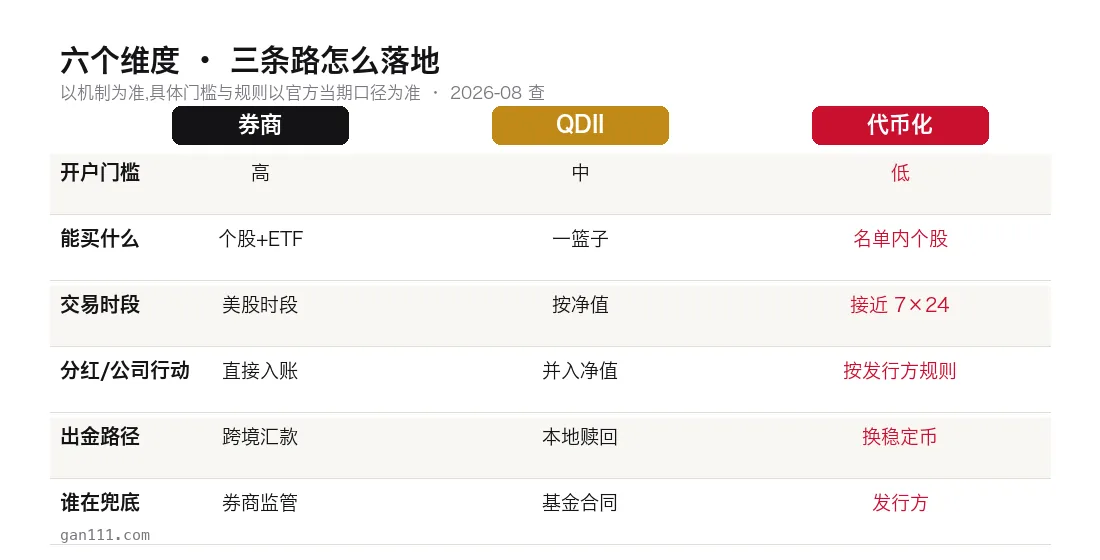
| Dimension | A · Broker, direct US access | B · Regulated route at home | C · Tokenized US stocks |
|---|---|---|---|
| Getting an account open | Identity, address, tax status declaration; mainland residents can no longer open new accounts (since 2026-05-22), existing ones may only sell and transfer out | An account you probably already have; minimums and suitability set by the product; Wealth Management Connect has its own eligibility rules | A platform account or a wallet, plus some stablecoin; restricted for mainland residents under Yinfa [2026] No. 42 |
| What you can buy | Single names, ETFs, options — the widest reach of the three | An index or a theme in a basket; usually not one named company (Stock Connect and Wealth Management Connect do not reach individual US stocks either) | Whatever is on the listed roster, typically large caps and a few ETFs |
| Trading hours | US regular session, with pre-market and after-hours at many brokers | Your own market hours; overnight US moves wait for your next session | Nominally around the clock, but thin books when the US market is shut |
| Dividends and corporate actions | Cash into the account and full shareholder rights; dividends may be withheld at source | Reflected inside the fund's value; nothing for you to handle | Issuer applies a multiplier to your balance; no voting rights |
| Getting money out | Back the way it came, with another currency conversion | Redeem into the account you already had, same currency | Sell into stablecoin, then a separate step back into your bank |
| Who is standing behind it | The investor-protection scheme of the broker's jurisdiction | Licensed manager plus independent custodian — the most complete of the three | The issuer: reserves, insolvency treatment and remedies are yours to verify |
The row to stare at is the last one. If something goes wrong on the first two routes, there is an institutional framework behind you that has been running for decades. On the third, what you can lean on is mainly the issuer and its documents. You will not notice the difference while trading normally; it only comes up if the issuer or the platform actually runs into trouble.
Any specific number about eligibility, minimums, limits or tax should not be copied out of an article, this one very much included. Those vary by jurisdiction and change without warning. Confirm the current version on the provider's own page before you move money; it takes a few minutes.
Three cases people get wrong
Abstract comparisons often leave you exactly where you started, so here are three typical situations. Wherever they mention opening a broker account or buying tokenized shares, they are for readers outside the mainland whose local rules allow it; from the mainland, only the fund route applies.
Case one: you just want one specific famous stock
Ask yourself one question first: do you want that company's price, or that company's share. If you only want the price movement and the amount is not large, tokenization gets you there fastest, as long as you accept that it is a shadow asset with no shareholder status attached. If you plan to hold for a long time, or you care about dividends landing as real cash, or you care about actually being on the register, then go and do the brokerage onboarding properly. The fund route is basically unusable in this case, because it cannot give you one company. The worst version of this is wanting real ownership, finding the onboarding annoying, settling for the token instead, and then holding it for three years. From the mainland, this case currently has no compliant answer — what you can buy is a fund that happens to hold the stock.
Case two: you want to drip-feed a broad index for years
This one inverts: tokenization is the least suitable of the three. Regular investing works by trading time for certainty, and the longer the horizon, the longer you are exposed to that extra issuer layer. For a little convenience, you would be adding a counterparty to a holding period that otherwise only carried market risk. Buying a listed fund or ETF in the account you already have, or setting up a recurring purchase of a US-listed ETF at a broker, both sit better here. The main thing to watch is the wrapper premium — try not to buy in when the listed fund is trading well above what it holds. If you want the tokenized version of index exposure anyway, read the piece on tokenized index products first, especially the part about leveraged wrappers.
Case three: you have a small amount and want to try it
Outside the mainland, where it is allowed, this is where tokenization genuinely stands up. On the broker route, the fixed cost of transferring and converting money would eat a real chunk of a small principal. The fund route can take small amounts too, but what you experience is a number moving in an app, which is still one layer away from how a stock market actually trades. Buying a small tokenized position and feeling the order, the spread, the quotes during a closed market and the full path back out to cash is decent value as tuition. The condition is that you treat it as tuition rather than as a position: decide that losing all of it would genuinely not bother you, and only then press buy.
Split by purpose, not one of three
My view is that these are tools with different jobs, not three candidates competing for the same job — but which of them are even legal for you comes first, and that depends on where you live.
From the mainland, the only box left to split is the domestic one: QDII funds and cross-border ETFs, plus Wealth Management Connect if you qualify, all of them basket exposure rather than single names. Outside the mainland, where local rules allow, a common split is: the part you intend to hold for a long time, where you want to be a shareholder in the real sense, sits at a broker; the tokenized part stays a small feel-for-it position, kept small deliberately for exactly the reason in the last row of that table.
The most annoying part is usually not any of the routes. It is reconciliation. Each one states its costs differently and converts currency differently, so working out whether you are actually up or down means keeping your own ledger — and it is far easier started early than reconstructed later. If you want to see how Binance's own stock trading (real shares paid for in USDC) works step by step, the walkthrough of buying US stocks on Binance with USDC follows the official pages.
This piece describes mechanisms and trade-offs and is not investment advice. Which road to take and how much to put in depend on your own situation, the current terms, and the restrictions that apply where you live.
Choosing between the three: follow-up questions
Can mainland Chinese investors still open a US brokerage account?
Not a new one. In its press Q&A of 22 May 2026 the CSRC said overseas institutions may not open new accounts for mainland investors; existing clients get a two-year rectification period during which they may only sell and transfer funds out, and service stops after that. The compliant channels from the mainland are Stock Connect, QDII and Wealth Management Connect, and of those, US exposure comes mainly through QDII funds and cross-border ETFs.
Does a US ticker on my local broker mean I own the share?
Not necessarily, and it is worth checking before you assume this route is the traditional one. Some local platforms hand you the actual share. Some route you into a contract that only tracks the price. Some hold a fractional entitlement in the firm's own name and pass the economics through to you. All three can be legitimate and regulated, and only the first one makes you a shareholder. The product page and the client agreement tell you which one you are getting. The ticker on the screen does not.
Which of the three routes is cheapest?
The question only means anything if you cost each one separately. On the broker route it is commission plus the cost of moving money and converting currency, and on a small amount the transfer leg can dwarf the commission. On the fund route it is the management and custody charge plus whatever you pay to get in and out, spread across how long you hold. On the tokenized route it is the spread, the network fee, and then the extra step of turning stablecoins back into money in a bank account. What they share is that the smaller the amount, the more the fixed costs dominate, so do not judge any of them by the headline rate alone.
Does buying a tokenized US stock count as owning the stock?
No. What you hold is a token created by the issuer, which buys and custodies the matching real shares in the background and mints tokens against them in proportion. You are not on the shareholder register, you have no voting rights, and entitlements reach you as an adjustment the issuer makes to your balance under its own published rules. The format gives you price exposure and a very low bar to entry, not shareholder status. Most of the time that distinction is invisible. It becomes visible all at once if the company or the issuer runs into trouble.
Can I use all three routes at the same time?
It depends on where you are. From mainland China: overseas brokers no longer open new accounts for mainland investors, existing accounts may only sell and transfer funds out during the rectification period, and tokenized stocks are restricted under Yinfa [2026] No. 42, so what is actually usable is QDII funds, cross-border ETFs and Wealth Management Connect. Outside the mainland, where local rules allow, splitting by purpose is usually clearer than picking a winner: hold the long-term part, where you actually want to be a shareholder, at a broker; do the plain index allocation through a fund inside the account you already have; and keep the tokenized part for small experiments. The genuinely annoying part is bookkeeping. The three routes quote costs and exchange rates differently, so keep your own simple ledger rather than expecting any one interface to add it all up for you.
Read next: What a tokenized stock actually is · If a tokenized share is halted or delisted · Selling and cashing out