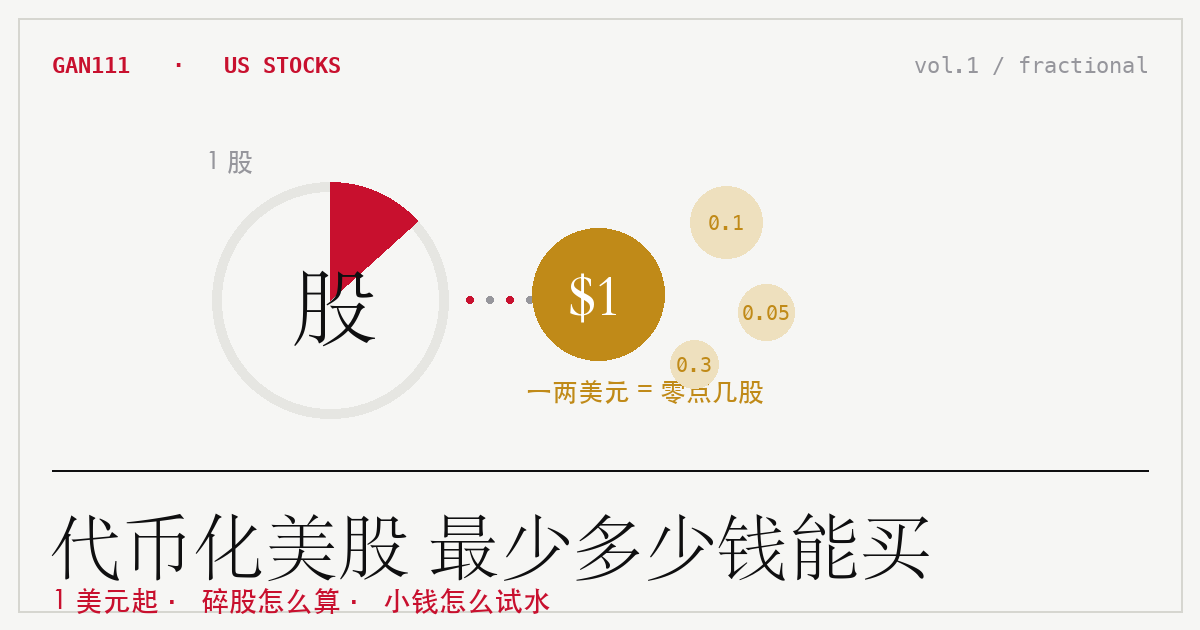
One share of whatever name everyone is talking about this month can cost more than you want to risk on a first trade, and that is where it is easy to stop. Tokenized US stocks quietly took that wall down: you never have to buy a whole share. A couple of dollars gets you a sliver of one. This piece skips the question of what tokenization is — there is a separate piece for that — and answers the plain one underneath it: what does it actually cost to get in, and does going small come with a catch nobody mentions.
Every minimum, fee and eligibility rule below is described as a range and reflects a check made in 2026-08. None of them are mine to set — the platform and the issuer own those numbers, and they move without telling anyone. Read this as a mechanics explainer and a personal view, not investment advice and not a recommendation of any ticker, issuer or platform, and confirm the current figures on the order page before you send money anywhere.
The short answer: very low, and each platform sets its own floor
Straight to it. On the venues that list tokenized US stocks, an order is denominated in money, not in shares. You type in how much you want to spend, the platform converts that at the going price, and you end up holding whatever fraction of a token your money bought. Because of that, the entry cost is set by the smallest order value the venue will accept, not by what one share happens to cost.
That floor differs by platform. Binance's stock trading service — real shares rather than tokens — states a minimum of 5 dollars; for xStocks bought through an on-chain wallet, the floor is whatever the order page shows. It is deliberately not a number worth memorising: the real minimum is whatever the order page or the token detail page shows at the moment you press buy, and it can differ between the spot market and the on-chain wallet route on the very same platform. If those two routes are still blurred together in your head, the piece comparing bStocks and xStocks puts them side by side.
So the marketing line about buying a famous stock with a few dollars is not a stunt. Mechanically, fractions hold up. For anyone with a small balance who wants to feel the thing work before committing anything real, that is the most concrete advantage this format has over buying whole shares through a broker.
How a fraction is priced: proportionally, not in whole numbers
Owning a tenth of a share can feel strange at first, and it really should not. It is the arithmetic you already did at school, just with a decimal point where you are used to seeing a round number.
Putting $30 into a token priced at $300
Say the token is trading at $300 and you spend $30. You get 0.1 of a token, carrying roughly a tenth of a share of price exposure. If the underlying gains 10 percent, your 0.1 gains 10 percent with it; if it drops, the same thing happens in reverse. Direction and percentage behave exactly as they would with a whole share. The only difference is that your quantity has a decimal point in it. Round figures used here purely to keep the arithmetic readable, not as any kind of quote.
So a fraction is not a separate product with its own rules bolted on. It is a slice of the same token everyone else is holding. Your balance may read 0.0873 or 0.1526, a string of decimals that looks faintly alarming the first time you see it, and all it represents is what you spent divided by the price at the moment you spent it.
One consequence worth internalising early: the order screen talks to you in dollars while your holdings are recorded in tokens, and those two only line up at the price you paid. Everything after that — a gain, a loss, a partial exit — is the same conversion running again at a different price. When you eventually sell and cash out, it simply runs backwards.
The platform figures in this piece are ranges from a check made in 2026-08, not quotes and not promises; the Solana token-account deposit follows Solana's own documentation. Minimums, fee schedules and country eligibility are set by the platform and the issuer and change without notice — the order page and the issuer's own product page are the only current sources worth trusting.
The same $100, whole shares versus fractions
Putting the two next to each other makes the point faster than another paragraph does. Assume you have $100 and nothing else to add this month. The share prices below are round placeholders picked to keep the arithmetic readable, not quotes for any particular company:
| What you want | Buying whole shares | Buying a fraction |
|---|---|---|
| A share priced around $200 (plenty of large-cap tech sits in this bracket) | Not enough for one share. No trade. | Roughly half a share of exposure |
| A share priced around $300 | Not enough for one share. No trade. | Roughly a third of a share of exposure |
| Spreading the $100 across three names | One name at most, and only if it is cheap | Three separate orders, a slice of each |
The prices in that table do not matter. The structural difference does: with whole shares, the cost of one share is a hard gate; with fractions, it is not a gate at all. That is why a token can be an easier first position in a big US name than a brokerage account.
It also changes what spreading your money around costs. Three tiny slices is a perfectly reasonable way to stop one name deciding your whole result — though if broad exposure is what you are actually after, a tokenized index product does that job in one order instead of three, and you pay one set of costs rather than three.
Does the network fee eat a small order alive?
This one comes up a lot: if I only put in two dollars, is the fee going to cost more than the trade? It deserves a proper answer, because the fee people are afraid of is usually not the fee that actually hurts them.
The xStocks tokens mostly live on Solana, where the network fee on each transaction is low. The cost people miss is a different one: the first time you hold a given token, the wallet has to open a token account for it and lock in a deposit of about 0.00204 SOL (2,039,280 lamports; Token-2022 tokens can need more, so go by the wallet's prompt). When you buy it yourself, that comes out of your SOL, and you get it back if you later close the account. So on a first two-dollar order, the deposit is a noticeable share of the money; after that, buying the same token again costs only the network fee. The fee itself is not a fixed number either: congestion and priority fees move it, and any figure printed in an article ages badly. Look at the wallet's own estimate on the confirmation screen.
| Cost | Rough size | What it means for a small order |
|---|---|---|
| Solana network fee | A base fee per signature plus an optional priority fee, moving with congestion | Small, but you have to hold some SOL in the wallet first or the transaction cannot go through at all |
| First-time token-account deposit | About 0.00204 SOL, once per token, refundable when the account is closed | A noticeable share of a first small order, and it is also paid in SOL |
| Spread and slippage | Entirely a function of the token's liquidity; thinly traded names are far worse | This, not the network fee, is what quietly erodes a small order |
| Platform fee | Some venues charge nothing extra on stock tokens, others do; the published fee schedule is the only source of truth | Read it on the platform's own page before the first order, since it can change |
So small orders are fine, but the smaller the order, the more liquidity matters. A heavily traded name has a tight gap between the price you can buy at and the price you can sell at; an obscure one can carry a spread several times the size of the network fee, and that gap is exactly where small money disappears without anyone sending you a receipt for it.
Timing feeds into the same thing. Quotes tend to be thinnest when the US market is closed and the people who normally arbitrage the token against the real share have gone home, which the piece on trading hours gets into properly. And if you have not settled on where to do any of this yet, how I go about picking a venue covers the rest of that checklist.
Three things to settle before you buy a fraction
A low floor is not the same thing as low risk, and the cheapness of the entry ticket makes it easy to skip the reading. Three things worth having straight first:
- It is not a real share. However small the slice, what you hold is a token that tracks a price. No voting rights, and dividends are typically handled by an adjustment or a reinvestment rather than paid to you as cash. If being a shareholder or collecting income is the point of the exercise, this is the wrong tool, and what a tokenized stock actually is walks through the structure underneath.
- Check that your country is eligible before you fund anything. These products are offered to non-US retail users in a specific list of countries, and the excluded list has included the US, Canada, the UK and Australia (checked 2026-08). That list belongs to the issuer, it is not the same on every route, and it moves. Before you transfer money in, check the restricted-country lists the issuer and the platform publish, then the rules where you live. Being able to reach the order screen in the app does not mean it is allowed where you are.
- Keep a little SOL around. Otherwise you end up in the mildly absurd position of holding stablecoins you cannot spend, because the network fee has to be paid in SOL and nothing else, and so does the deposit for a token you are buying for the first time. Go by the wallet's prompt for how much, and top it up before you need it rather than in the middle of a trade you want to close.
A small amount of money does not mean a small percentage at risk. A wide spread on a thin name, a regional block you discover halfway through, a congested network on the day you want out — any one of them can take a meaningful bite out of a two-dollar position. A small order still deserves the same care as a real one.
How I would do it: run the whole loop with ten dollars
If this is your first time, the advice is simple. Do not try to get it right in one big order. Take an amount you genuinely would not miss and run the entire loop end to end. Four steps, and the fourth is the one people skip:
- Fund. Move a little SOL for fees and the first-time token-account deposit, plus a few dollars of stablecoin, from your spot account into the Web3 wallet. Internal transfers like that are usually near-instant and never touch the chain, so they cost no gas.
- Buy. In the wallet's stock token section, pick a heavily traded name and order by amount rather than by quantity — five dollars' worth, say. Look at the quoted spread and the slippage estimate before you confirm rather than after.
- Sell. A while later, swap it back. This is where you find out what the round trip really costs, and no article can tell you that number for your own order.
- Withdraw. Move the stablecoin back to the trading account and confirm the whole path worked and the total cost landed roughly where you expected it to.
One lap of that and you have a genuine feel for the minimum, the fee, the spread and how long each leg takes — worth more than ten how-to articles, this one included. If you want the click-by-click version of the middle two steps, the five-step walkthrough for buying xStocks from a Web3 wallet follows the same route, and the piece on buying US stocks on Binance with USDC covers the other route, based on the official pages.
The above describes the mechanics and my own view, not investment advice. Whether to buy at all, and how much, is yours to decide after you have checked the current terms, the fees and the restrictions that apply where you live.
Small-order questions
What is the smallest amount I can put into a tokenized US stock?
Very little, but the floor differs by platform. Because orders are placed by amount, a few dollars can buy a fraction of a Tesla token; the exact minimum is whatever the order page shows at the time you buy, because it is set by the platform and it changes. For comparison, Binance's stock trading service (real shares, not tokens) states a minimum of 5 dollars. What actually stops people is rarely the minimum. An on-chain order also needs a little SOL sitting in the wallet to pay the network fee and, the first time you buy a given token, its token-account deposit, so budgeting your stablecoin plus a small SOL buffer makes the first trade far less fiddly.
How is a fractional share priced, and what does holding 0.1 of a share mean?
Orders are denominated in money rather than in whole shares. You choose how much to spend and the platform converts it at the going price into the matching fraction of a token. If the token is at 300 dollars and you spend 30, you hold 0.1 of it, which carries roughly a tenth of a share of price exposure. Gains and losses run at that same proportion, exactly as a whole share would, just with a decimal point in the quantity.
Will the network fee eat my money if I only trade a few dollars?
Watch the first order. The network fee on each Solana transaction is low, but the first time you hold a given token the wallet opens a token account for it and locks in about 0.00204 SOL (refundable when the account is closed; Token-2022 tokens can need more). On a two-dollar first order that deposit is a noticeable share; buying the same token again afterwards costs only the network fee. The other cost to watch is the spread. On a thinly traded token the gap between the buy price and the sell price can be several times the network fee, so if you are testing with small money, stay with heavily traded names where that gap is tightest.
What is the sensible way to test this with a small amount?
Do not try to get everything right in one order. Take an amount you would genuinely not miss and run the full loop once: fund the wallet, buy, sell, withdraw. Check that each leg clears, that the timing matches what you expected and that the total cost is what you were quoted, and only then think about size. If something does go wrong at a regional restriction or on the chain, the lesson costs you a few dollars instead of a real position.
Read next: Buying xStocks from a Web3 wallet, step by step · What a tokenized stock is · Selling and cashing out