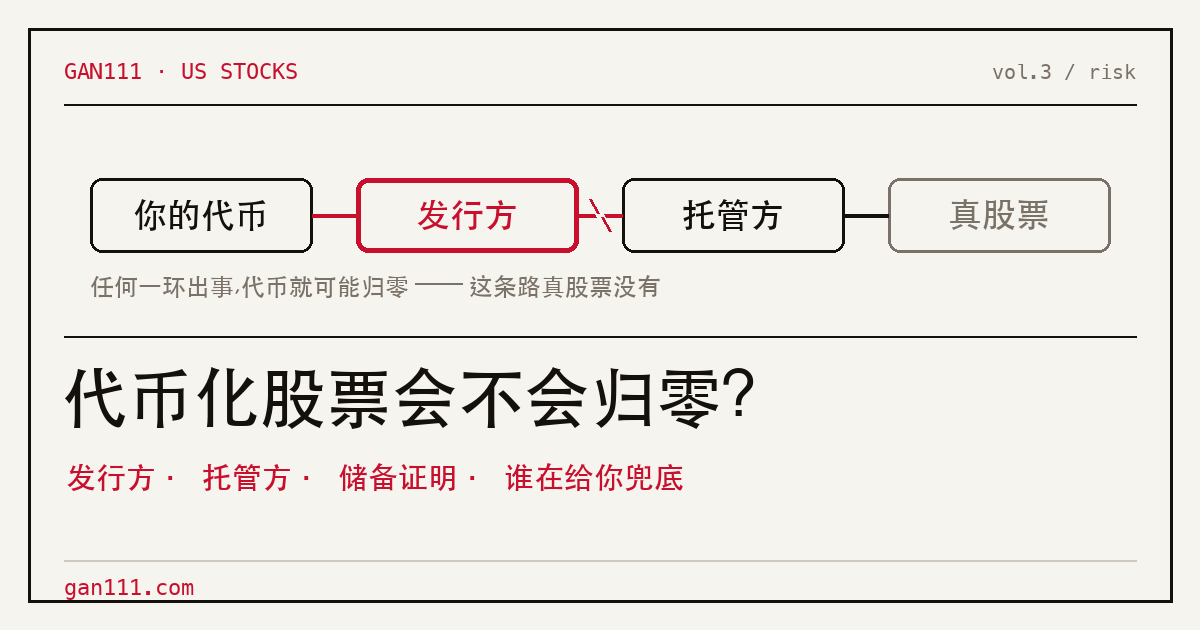
Before you buy a tokenized share, stop on the question underneath it: why is this token worth anything? Not because there is code on a chain. It is worth something because, in theory, an issuer bought a real Apple share, parked it with a regulated custodian, and minted your token against it. That chain of promises is the product. It is also the one path to zero that a real share does not have, and it is what this piece is about.
Two different ways the number goes down
When a tokenized share loses value, the cause is one of two unrelated things, and running them together is where the confusion starts.
- The company falls. Apple drops, your Apple token drops with it. That is identical to holding the real share. It is the market risk you signed up for, and it is not the format's fault.
- The wrapper breaks. The issuer becomes insolvent, a regulator halts the product, the custodian fails or was not holding what it reported. Now the token can be suspended, trade at a discount, or be wound down while the company itself is trading normally. This layer is the one that belongs to tokenization.
Only the second one is the subject here. The first is ordinary equity risk, and the explainer on what a tokenized stock is covers how the two sit on top of each other.
What you are holding is a claim on the issuer
The chain behind one tokenized share usually runs like this: an issuer — Backed and Ondo are the names you will run into most — buys the real shares through a licensed broker, hands them to a third-party custodian, and mints tokens against them one for one on chain. You buy the token.
The important part of that sentence is what is missing from it. You are not on the shareholder register. You have no vote. What you own is an entitlement against the issuer, enforceable on the terms the issuer has published. And the thing you are trusting is not the blockchain: the chain will record your transfer perfectly well, and would go on recording it perfectly well if the shares behind it were gone. What you are trusting is that every institution in that chain does what its documents say it does.
Counterparty risk did not disappear here. It moved. On the brokerage route it sits with a licensed broker inside a settlement system with decades of case law behind it. Here it sits with a company and its paperwork. The comparison of the three routes into US stocks sets that difference out row by row.
Bankruptcy remoteness: what the structure does, and where it stops
A serious issuer does not want its own failure to take the assets down with it, and the standard answer is to put the assets somewhere that failure cannot reach. Ondo, for one, publishes a structure in which the underlying assets sit in a bankruptcy-remote SPV — a separate entity created for that single purpose — with a security agent appointed to hold a first-priority claim over them on behalf of token holders. In plain terms: if the issuing entity goes under, that pool of shares is not supposed to become part of its bankruptcy estate, and is supposed to go to holders first. Ankura Trust acts as security agent, or in a related trustee role, in Ondo's structure; Ondo's own documents are the reference for the details.
That is real engineering and it is worth looking for. But be precise about what it covers. Bankruptcy remoteness is a defense against one specific event: the issuing entity's own insolvency reaching assets that are meant to be yours. It does nothing about:
- a custodian that fails, or that was not holding what it reported;
- a regulator suspending or banning the product where you live, which can stop you trading or redeeming regardless of who owns what;
- failure in the technical layer — the contract, the bridge, key management;
- time and haircut. Even a structure that works has a process, and processes take months and rarely hand back everything.
The word doing the heavy lifting in all of this is supposed. Whether the structure holds, how long enforcement takes, and what fraction actually comes back depend on the specific legal documents and on the circumstances at the time. Bankruptcy remoteness lowers the risk. It does not remove it, and an issuer being straight with you will say so in its own materials.
Three things to check before you buy
A recognizable brand is not diligence. Take the time to run these three checks; each one targets a different way this can go wrong.
- Proof of reserves. Major issuers publish it, and some push it on chain through an oracle so it can be verified without taking anyone's word for it. What you want is to be able to compare the tokens in circulation against the shares reported in custody. If there is no reserve reporting at all, you can stop there.
- The custodian and its license. Which institution is holding the real shares, and who regulates that institution. A custodian that is unnamed or described vaguely is a red light by itself.
- The legal documents. Offering documents, attestations or audits, and specifically the insolvency clauses. Read what is actually promised, and to whom. An issuer that puts all of this in front of you is telling you something about itself, and so is one that does not.
SIPC does not cover this, and neither does deposit insurance
This is the assumption I would most like to break, because it comes so easily: I bought it on a big platform, so if it blows up somebody makes me whole. Not here.
SIPC exists for one situation: a SIPC-member US broker-dealer fails and customer securities or cash are missing from the accounts it held. Customer property is returned, with SIPC covering shortfalls up to a per-customer cap. SIPC protection has a limit, and the current amount is on the SIPC website.
Two limits matter more than the amount. SIPC does not cover losing money. If your position halves, nothing happens, because that is not what the scheme is for. And SIPC only reaches assets held in an account at a member firm. A tokenized share is created by an issuer, held by a custodian, and sits in your exchange account or your own wallet. None of those is a SIPC-member brokerage account, so holders of tokenized shares are outside SIPC's protection.
Deposit insurance is a different scheme with the same answer. It covers bank deposits. It does not cover securities, and it does not cover tokens, including the stablecoins you bought with. Your entire protection here is the issuer's custody arrangement and legal structure, and there is no public backstop behind it.
Coverage limits, eligibility and the restrictions that apply where you live all change, and none of them should be taken from an article, this one very much included. Before you move money, confirm the current version at the source: the issuer's documents, the venue's terms, and your own regulator.
So: buy, or not?
Both of the quick answers, buy it and relax or stay away because it is a scam, are too simple. Tokenized shares are not a scam, and they should not be treated as a savings account either. What to work out before buying is which layer of risk you are carrying.
The format fits someone who understands the wrapper, keeps the position small, and has actually run the three checks above. What it gives you is real: exposure to a US name, around the clock, at sizes and with an onboarding no broker would bother with. What it costs you is an extra counterparty and the absence of any investor-protection scheme behind it. Whether that cost is acceptable depends mostly on how large the position is. The mistake that is easiest to miss is deciding the format is fine because nothing has gone wrong yet, and letting the position grow into something that would hurt.
The practical version, offered as a reference point rather than a recommendation: I size these on the assumption that the thing that breaks will be the wrapper rather than the company. In practice that means keeping them small enough that a suspension would be irritating rather than serious, and knowing the exit before I need it. Selling and cashing out is its own path with its own cost, and what you actually get back if a token is halted or delisted is worth reading while nothing is going wrong.
This piece describes mechanisms and trade-offs and is not investment advice. Whether to buy, how much, and through which issuer depend on your own situation, the issuer's current documents, and the restrictions that apply where you live.
More on the issuer layer
Can a tokenized stock actually go to zero?
It does not go to zero for being a token. What it has is one extra path to zero that a real share does not: the issuer or the custodian failing. Your token is worth something on the assumption that the issuer really is holding the matching shares at a regulated custodian, one for one. If the issuing entity becomes insolvent, a regulator halts the product, or something goes wrong in custody, the token can be suspended, redeemed at a discount, or wound down while the underlying company keeps trading normally. Price risk on the company is one thing and you signed up for it. The wrapper layer is the part that belongs to the format, and it is the part to be clear-eyed about before you buy.
If the issuer goes bankrupt, do I get my money back?
It depends on the structure and there is no general answer. Serious issuers build for this. Ondo, for one, publishes a structure in which a bankruptcy-remote SPV holds the underlying assets and a security agent preserves a first-priority claim over them for token holders, so that if the issuing entity fails those shares are not supposed to fall into its bankruptcy estate. Whether that runs smoothly, how long it takes and what fraction comes back all depend on the actual legal documents and on the circumstances at the time. Read the issuer's own legal disclosures before you buy rather than trusting the name on the product.
How do I check that the real shares are actually there?
Three things. First, proof of reserves: major issuers publish it and some feed it on chain through an oracle, so you can compare the tokens in circulation against the shares reported in custody. Second, the custodian: who is holding the shares, and under whose license. Third, the legal paperwork: offering documents, attestations or audits, and the clauses that describe what happens in an insolvency. If any of the three is missing or written vaguely, that is your answer. A recognizable ticker on a token tells you nothing about what stands behind it.
Does SIPC or deposit insurance cover tokenized stocks?
No. SIPC covers customers of SIPC-member US broker-dealers when the firm fails and customer securities or cash go missing, up to a cap; SIPC protection has a limit, and the current amount is on SIPC's own website. It never covers a fall in value, and it does not reach assets that are not held in an account at a member firm. A tokenized share sits with an issuer and a custodian outside that perimeter, so none of it applies. Deposit insurance is a different scheme again: it covers bank deposits, not securities and not tokens. Whatever protection you have here comes from the issuer's custody arrangements and legal structure, and from nothing else.
The venue I bought it on is large. Does that make it safer?
A bigger venue changes who you are trusting; the number of parties you have to trust stays the same. A large venue is where the trade happens and it normally applies its own listing standards, but the promise that a real share stands behind the token is made by the issuer, in the issuer's documents. Read the venue's terms and see what it says it is responsible for; usually it describes itself as the place you trade, not as the guarantor of the instrument. You will not notice the difference while trading normally; if the issuer runs into trouble, the commitments that matter are the issuer's and its documents, and the venue may not step in.
Read next: What a tokenized stock actually is · If a tokenized share is halted or delisted · Three routes into US stocks, compared