After you sell a US stock, a small regulatory charge may show up on the trade confirmation under two names, the SEC fee and TAF. For trades from October 1 through December 31, 2026, TAF is paused; the SEC fee still applies, at $20.60 per million dollars of sale proceeds. Both attach to sells only, and a buy generates neither.
To estimate the charge on a sale of your own, you need two numbers: the dollar amount of the sale and the number of shares sold. The SEC fee follows the amount and TAF follows the share count. On the same $10,000 sale, 20 shares of a high-priced stock and 5,000 shares of a low-priced one both carry a $0.206 SEC fee, while TAF at the 2026 rate is $0.0039 for one and $0.975 for the other. The rates here are the ones published on the SEC, FINRA and Binance pages in October 2026.
How is the 2026 SEC fee of $20.60 per million calculated?
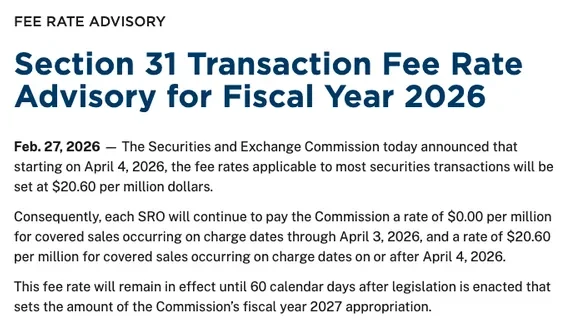
The SEC fee's formal name is the Section 31 transaction fee, after Section 31 of the Securities Exchange Act of 1934. In its Section 31 Transaction Fee Rate Advisory for Fiscal Year 2026, the SEC set the rate for "most securities transactions" at $20.60 per million dollars starting on April 4, 2026. The rate stays at $0.00 per million for covered sales on charge dates through April 3, 2026, and is $20.60 per million for covered sales on charge dates on or after April 4. For the definition of "charge date", the advisory points readers to Rule 31(a)(3).
The formula:
SEC fee = sale amount × 20.60 ÷ 1,000,000
On a $10,000 sale: 10,000 × 20.60 ÷ 1,000,000 = $0.206. As a percentage, that's 0.00206% of the sale amount. A few other amounts:
| Sale amount | Calculation | SEC fee |
|---|---|---|
| $1,000 | 1,000 × 20.60 ÷ 1,000,000 | $0.0206 |
| $10,000 | 10,000 × 20.60 ÷ 1,000,000 | $0.206 |
| $50,000 | 50,000 × 20.60 ÷ 1,000,000 | $1.03 |
| $100,000 | 100,000 × 20.60 ÷ 1,000,000 | $2.06 |
| $1,000,000 | 1,000,000 × 20.60 ÷ 1,000,000 | $20.60 |
The figures in the table come straight from the formula, with every decimal place kept. How your broker rounds the charge and what it calls it on the confirmation are set out in the broker's own fee disclosure.
The rate's end date is tied to an appropriations bill: it remains in effect until 60 calendar days after legislation is enacted that sets the SEC's fiscal year 2027 appropriation. Later changes will be posted on the Fee Rate Advisories page of the SEC website. Security futures don't use this rate: the assessment on them stays unchanged at $0.0042 for each round turn transaction. The rate adjustments also don't directly affect the amount of funding available to the SEC.
TAF is charged per share sold and capped at $9.79 per trade
TAF stands for Trading Activity Fee, a fee assessed by FINRA (the Financial Industry Regulatory Authority). In FINRA's Fee Adjustment Schedule, the 2026 TAF for a Covered Equity Security is "$0.000195 per share (up to $9.79 max per trade)". Like the SEC fee, it counts only the sell side: on FINRA's Trading Activity Fee page, the notices announcing past rate changes are titled as applying to "Sales of Covered Equity Securities", and the Binance stock fee page labels the same line "sell side only". The dollar size of the trade doesn't change it.
TAF = shares sold × 0.000195, charged at $9.79 when the result is higher than $9.79
| Shares sold in one trade | Calculation | TAF |
|---|---|---|
| 100 shares | 100 × 0.000195 | $0.0195 |
| 500 shares | 500 × 0.000195 | $0.0975 |
| 5,000 shares | 5,000 × 0.000195 | $0.975 |
| 50,000 shares | 50,000 × 0.000195 | $9.75 |
| 60,000 shares | 60,000 × 0.000195 = 11.70, above the cap | $9.79 |
The share count where the cap starts to bind: 9.79 ÷ 0.000195 ≈ 50,205.13. A single sale of 50,205 shares works out to $9.789975, still under the cap; 50,206 shares works out to $9.79017, and from there on TAF stays at $9.79.
On a sell order with a low share price and a lot of shares, TAF stands out more than the SEC fee. A sale of 5,000 shares at $2 each is $10,000 in proceeds, with an SEC fee of $0.206 and TAF of $0.975. The $0.000195 and $9.79 figures are the rate for stocks; options have their own row in the same schedule, priced per contract.
TAF is paused on US stock sales in the fourth quarter of 2026
In rule filing SR-FINRA-2026-021, FINRA proposed to temporarily pause assessment of TAF for three months, for transactions from October 1, 2026 through December 31, 2026. The matching notice on the SEC's website is Release No. 34-106409, its title includes Immediate Effectiveness, and public comments are due October 14, 2026.
The pause applies to FINRA's assessment on its members, meaning the brokers, so for those three months FINRA itself doesn't collect TAF; how the line appears on your trade confirmation is up to your broker. For a sale of 500 shares worth $10,000, at FINRA-level rates:
| Item | Charged normally at 2026 rates | Trades from October 1 to December 31, 2026 |
|---|---|---|
| SEC fee | 10,000 × 20.60 ÷ 1,000,000 = $0.206 | $0.206 |
| TAF | 500 × 0.000195 = $0.0975 | $0 |
| Both together | 0.206 + 0.0975 = $0.3035 | $0.206 |
Charged normally, this sale comes to $0.3035 in total, and the pause takes $0.0975 off. I wouldn't move a sale date for an amount this small; the day to sell stays whatever it was going to be.
The pause runs through transactions on December 31, 2026. For sales from January 2027 on, look up the TAF rate in effect on FINRA's website at that point, and after the trade compare it with the amount actually charged on your confirmation.
Does the SEC charge the SEC fee to retail investors directly?
The SEC's "SEC Fee" page explains that although some broker-dealers have described the charge as an "SEC Fee", "the SEC does not actually impose this fee on individual investors", and it doesn't impose or set any of the fees investors pay their brokers either. The money is passed along in three steps:
- Under Section 31 of the Securities Exchange Act of 1934, self-regulatory organizations (SROs) such as FINRA and all of the national securities exchanges must pay transaction fees to the SEC based on the volume of securities sold on their markets.
- The SROs have adopted rules that require their broker-dealer members to pay a share of these fees.
- Broker-dealers, in turn, charge their customers fees that provide the funds to pay what they owe their SROs.
So the party collecting the line on your confirmation is your broker. A customer with questions about how the fee is calculated should contact the broker-dealer, and a broker-dealer should contact its SRO. The fees are designed to recover the costs the government, including the SEC, incurs for supervising and regulating the securities markets and securities professionals.
TAF is FINRA's own fee, and its rate schedule is posted on FINRA's website. How your broker handles it is, again, a matter for the trade confirmation and the broker's fee disclosure.
Checking the two fees against your trade confirmation
- Find the sale on the confirmation and note its dollar amount and the number of shares.
- Multiply the amount by 20.60 and divide by 1,000,000 to get the SEC fee.
- For a trade dated October 1 through December 31, 2026, FINRA itself isn't collecting TAF, and whether the line appears on the confirmation, and for how much, is up to your broker. For sales on other dates in 2026, multiply the shares by 0.000195 and use $9.79 if the result is higher.
- Compare the results with the amounts actually charged on the confirmation. If the gap comes down to rounding, see the broker's fee disclosure; if it's larger, ask the broker how it calculates the charge.
Binance absorbs the SEC fee and TAF when you sell US stocks there
Under Zero Regulatory Fees, the Binance stock fee page says: "Binance absorbs all mandatory SEC and FINRA regulatory fees on your behalf. You will not be charged for any of these fees." Section 4 of the page, Regulatory Fees, lists three items in a table:
| Regulatory fee | Fee to you | Original rate listed on the page (absorbed by Binance) |
|---|---|---|
| SEC Transaction Fee (sell side only) | $0.00 | $20.60 per $1,000,000 of sale proceeds |
| FINRA Trading Activity Fee (sell side only) | $0.00 | $0.00 / Share |
| Consolidated Audit Trail (CAT) Fee | $0.00 | $0.000003 per covered order |
Regulatory fees are zero, but a sale still carries Binance's own charges. Under Trading & Account on the same page, orders with a trade value of $340 and above pay a 0.10% trading spread, and orders with a trade value of $340 and below pay a $0.35 platform fee. Under Others, American Depository Receipts (ADRs) are listed at $0.01 to $0.03 per share as pass-through fees.
Notes at the bottom of the fee page say the regulatory fee rates (SEC, FINRA, CAT) are set by the respective authorities and may change without prior notice from Binance, and that these fees are currently absorbed by Binance and are not charged separately to users. The same notes say the fee schedule applies to Direct Equities (US stocks and ETFs) only, and that Tokenized Stocks and other products are subject to separate fee schedules.
SEC fee rate adjustments
How often does the SEC fee rate change?
Once a year, and in some years again at mid-year. Section 31 of the Securities Exchange Act requires the SEC to keep its total collection of transaction fees in a given year as close as possible to the regular appropriation Congress gives it for that fiscal year: when transaction volume rises, each trade has to contribute less and the rate is lowered; when volume falls, the rate is raised. The current rate is posted on the Fee Rate Advisories page of the SEC website.
Read next: Sold your US stocks on Binance? Getting the money out · Ex-dividend date or record date? The last day to buy and still get the dividend · What is an ADR? The depositary fee on Binance stocks · Do US stocks have price limits? Circuit breakers and LULD