To get a particular US stock dividend, you have to buy before the ex-dividend date; buy on that date or later and this dividend goes to the seller. Under today's T+1 settlement, the ex-dividend date is usually set on the record date itself, and if the record date isn't a business day, it moves back one business day. Your last day to buy is the final trading day before the ex-dividend date.
The two dates do different jobs. The company sets the record date, and whoever is on its shareholder register that day gets this dividend. The ex-dividend date follows exchange rules, and anyone who buys from that day on doesn't. If you've read a different account of how the two dates relate somewhere else, check what year it was written and compare it with the three official pages cited below.
What's the last day to buy a US stock and still get the dividend?
Investor.gov, the SEC's investor education site, sets out the rule in its Ex-Dividend Dates glossary entry: buy on or after the ex-dividend date and you won't receive the next dividend, which goes to the seller; buy before the ex-dividend date and the dividend is yours. It gives two examples, both for a company called XYZ, with dates in March 2026:
| Date | Example 1 (record date on a Monday) | Example 2 (record date on a Sunday) |
|---|---|---|
| Declaration Date | Monday, March 2 | Monday, March 2 |
| Record Date | Monday, March 16 | Sunday, March 15 |
| Ex-Dividend Date | Monday, March 16 | Friday, March 13 |
| Payable Date | Tuesday, March 17 | Tuesday, March 17 |
| Last day to buy (final trading day before the ex-dividend date) | Friday, March 13 | Thursday, March 12 |
In Example 1 the record date, March 16, is a Monday, and the ex-dividend date is set on that same day. Investor.gov's conclusion is that anyone buying on or after March 16 doesn't get this dividend. Counting back, March 14 and 15 fall on a weekend with the market closed, so the last day to buy is Friday, March 13.
In Example 2 the record date, March 15, is a Sunday, so the ex-dividend date moves back one business day to Friday, March 13. Buying on that Friday is already too late, which makes Thursday, March 12 the last day. Both examples share a payable date and their record dates are one day apart, so the last day to buy shifts by a day as well.
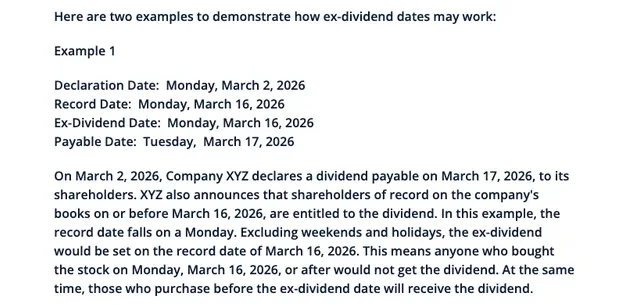
To work it out for a stock you're watching, count back from the ex-dividend date to the nearest US trading day. Skip any weekend in between, and skip US market holidays too; Investor.gov's examples say "Excluding weekends and holidays." For which days the market is closed and when your order settles, go by what your broker or platform shows, and check the ex-dividend date field on the stock's page before you place the order.
How is the ex-dividend date different from the record date for US stocks?
| Item | Record date | Ex-dividend date |
|---|---|---|
| Who sets it | The company, when it declares the dividend | Set under the stock exchange's rules once the company has fixed the record date |
| What it governs | Whoever is on the company's shareholder register that day is entitled to this dividend | Anyone who buys on or after this day doesn't get this dividend |
| What it means for your order | It's about the register and doesn't tell you directly which day to buy | It tells you directly from which day a purchase comes without the dividend |
A complete dividend payment involves four dates: the declaration date, the record date, the ex-dividend date and the payable date, and the money goes out on the payable date. Investor.gov mentions one more use of the record date: the company uses it to decide who receives materials such as proxy statements and financial reports.
As I see it, a retail investor placing an order only needs to watch the ex-dividend date. Whether you're on the register depends on when your purchase settles, and the ex-dividend date already has that settlement time built in.
Why is the ex-dividend date the same day as the record date under T+1?
T+1 means a trade settles one business day after it's executed. Run Example 1 through it: buy on Friday, March 13, and the trade settles on Monday, March 16, putting you on the register right on the record date. Buy on Monday, March 16, and settlement waits until Tuesday, so you're not yet on the register on the record date. The first day a purchase no longer carries the dividend is the record date itself.
For cash dividends, the three official pages describe the current rule the same way (stock dividends come up in the next section):
- NYSE's Ex-Date Dividends page: "The dividend Ex-Date is set for stocks on the record date, according to the current T+1 settlement cycle except under specified circumstances."
- FINRA Rule 11140(b)(1): for cash dividends, and for stock dividends worth less than 25% of the security's value, the ex-dividend date is the record date when the record date is a business day; when the record date falls on a non-settlement day, the ex-dividend date is the first business day before the record date. This assumes the definitive information arrives sufficiently in advance of the record date.
- Investor.gov: "The ex-dividend date for stocks is usually set as the record date or one business day before if the record date is not a business day."
When doesn't the ex-dividend date fall on the record date?
| Situation | Where the ex-dividend date lands |
|---|---|
| The record date isn't a business day | The first business day before the record date. Example 2 is this case: record date on a Sunday, ex-dividend date on the Friday |
| A cash or stock dividend worth 25% or more of the security's value | The first business day after the payable date. Investor.gov reworks its two examples for this case: with a payable date of Tuesday, March 17, the ex-dividend date becomes Wednesday, March 18 |
| Dividends paid in stock, and stock splits | FINRA 11140(b)(1) puts stock dividends worth less than 25% of the security's value in the same rule as cash dividends, with the ex-dividend date on the record date; (b)(2) covers stock dividends of 25% or more and stock splits, with the ex-dividend date on the first business day after the payable date. Investor.gov's passage on stock dividends doesn't mention 25%. It only says the procedures may differ from those for cash dividends and that the ex-dividend date is set on the first business day after the stock dividend is paid, which also puts it after the record date. If you run into one of these, go by the ex-dividend date shown in the stock's announcement or on its quote page |
| Stock dividends and splits on ADRs and foreign securities | Designated by a FINRA committee |
| The definitive information doesn't arrive sufficiently in advance of the record date | A FINRA committee designates the first practicable business day based on the circumstances |
In the cases where the ex-dividend date comes after the payable date, don't rush to sell just because the record date has passed. On stock dividends, Investor.gov explains that selling before the ex-dividend date also sells your right to the stock dividend. The sale carries an obligation to deliver the shares received from the dividend to the buyer, and the seller receives an IOU from the broker called a due bill. The day you can sell without handing over the new shares is usually the first business day after the stock dividend is paid, not the first business day after the record date.
The NYSE page is itself a report listing only the cases where the ex-dividend date isn't set on the record date, and the example it shows is one with a due bill attached; you can filter it by record date range and by ex-dividend date range. To confirm whether an NYSE stock is one of the exceptions, look it up there. For ADRs, the ex-dividend date on stock dividends and splits is designated by a FINRA committee.
Meta's September 2026 dividend record date and the METAB snapshot time
Here's how the rules play out on a payment that has already happened. On September 10, 2026, Meta announced a quarterly cash dividend of $0.525 per share on both its Class A and Class B common stock, payable on September 28 to stockholders of record as of the close of business on September 21.
The announcement gives only two dates, the record date and the payable date; the ex-dividend date isn't in it. The next two dates are my own working under the current T+1 rule. September 21 is a Monday, so the record date is a business day and the ex-dividend date comes out on the same day, September 21, with a last day to buy of Friday, September 18. You can check the 25% line too: 0.525 ÷ 25% = 2.1, so as long as the share price is above $2.10, this dividend is under 25% of the security's value. For META's actual ex-dividend date that time, go by what your broker's page shows and compare it with this working.
Binance's bStocks go by the snapshot time in the announcement. Binance's dividend announcement published on September 18, 2026 states that users holding AVGOB, QQQB and METAB at the snapshot time, 00:00 UTC on September 21, 2026, receive the dividend. The net cash dividend, after applicable withholding tax, fees, costs and other charges, is reinvested into additional shares of the same underlying and distributed as the corresponding stock token; holders on-chain receive it through a multiplier adjustment. 00:00 UTC on September 21 is 8:00 p.m. on Sunday, September 20 in US Eastern daylight time. In the same announcement STXB's snapshot is 00:00 UTC on September 24, so snapshot times are set stock by stock.
| Time (UTC) | What the announcement schedules for METAB |
|---|---|
| Sept. 18, 23:30 | The token conversion service for 1:1 conversion between META shares and METAB is suspended |
| Sept. 20, 23:30 | METAB deposits and withdrawals are suspended; Binance Convert suspends conversions for METAB and related pairs |
| Sept. 21, 00:00 | Snapshot: users holding METAB at this moment receive the dividend |
| After the distribution is complete | Deposits, withdrawals and token conversion resume with no further announcement |
The announcement also says METAB/USDT trading isn't affected, and dividends on holdings in other accounts, such as savings and margin accounts, are credited to the spot account. If you're moving METAB from on-chain into Binance to take part in the snapshot, the announcement advises leaving enough time before the suspension for the deposit to complete.
Do you still get the dividend if you sell on the ex-dividend date?
If you already held the stock before the ex-dividend date and only sell on the ex-dividend date itself, this dividend is still yours. That follows from Investor.gov's rule: anyone who buys on or after the ex-dividend date doesn't get this dividend, which goes to the seller.
For stock dividends, and for large dividends worth 25% of the security's value or more, the ex-dividend date can come after the payable date, so check which day it is before selling.
Does a US stock drop by the dividend amount on the ex-dividend date?
With a large dividend, the stock price may fall by roughly the amount of the dividend on the ex-dividend date. That line comes from Investor.gov's section on special dividends, and the word it uses is may: it describes a possibility, not a drop by the dividend amount every time.
Where the stock actually opens that day only shows up in the quotes once trading starts. Anyone buying on the ex-dividend date doesn't get this dividend, so factor that in when you place the order.
Read next: Do tokenized stocks pay dividends? How reinvestment and splits work · What is an ADR? The depositary fee on Binance stocks · Do US stocks have price limits? Circuit breakers and LULD · GOOG vs GOOGL: the difference, and what GOOGLx tracks