A US stock can jump dozens of percent in a day with no limit-up to stop it, so it's natural to wonder whether US stocks have price limits at all. They don't, at least not the daily limit-up and limit-down caps China's A-share market uses: there is no ceiling or floor on how far a stock can move in a day. What the US has instead is two brakes: a market-wide circuit breaker that stops everything, and LULD, which stops one stock at a time. The circuit breaker watches how far the S&P 500 falls in a day, with levels at 7%, 13% and 20%. LULD draws a band around each stock that moves with its trading price, and if the quote stays pinned at the edge of that band for 15 seconds, that stock stops for 5 minutes.
Both brakes explain that big up day. All three circuit breaker levels are declines, so no rally, however large, can trip them. The LULD band does have an upper edge, but it is centered on the average trade price over the previous five minutes: as the price climbs step by step, the band climbs with it, and only a move that comes too fast gets stopped. A stock that surges all day may have been paused several times along the way, at least 5 minutes each time, and after the close your quote app shows nothing but the day's percentage gain.
Why US stocks have no daily price limit like China's A-shares
China's A-share market caps how far a stock can move in a day. The US takes a different route: instead of fencing prices in, it stops trading for a while when the market falls far enough that liquidity could run dry, or when a single stock moves too violently. Investor.gov, the SEC's investor education site, files all of these under circuit breakers and splits them into two layers by scope:
| Question | Market-wide circuit breaker | Single-stock LULD |
|---|---|---|
| What it watches | How far the S&P 500 has fallen from the prior close | Whether the stock's quote has reached the edge of its price band |
| Trigger | Declines of 7%, 13%, 20% | 5%, 10%, 20% and so on either side of the reference price, depending on tier and share price |
| How long it stops | 15 minutes, or for the rest of the day | 5 minutes, extendable by another 5 |
| Can a rally trigger it? | No, all three levels are declines | Yes, the band has an upper edge |
| When it applies | During the trading day, handled differently before and after 3:25 p.m. ET | Regular session, 9:30 a.m.–4:00 p.m. ET |
How far the S&P 500 has to fall before a US circuit breaker kicks in
Nasdaq Trader's Market Wide Circuit Breaker page and Investor.gov's glossary entry on circuit breakers describe the same scheme: the US equity, options and futures exchanges have agreed in advance to halt trading together across markets in a severe decline and, in extreme cases, to close before the normal end of the session. Whether it triggers depends on how far the S&P 500 has fallen from the prior day's close:
| Level | Drop from prior close | Triggered before 3:25 p.m. ET | Triggered at or after 3:25 p.m. |
|---|---|---|---|
| Level 1 | 7% | Market-wide halt for 15 minutes | No halt; trading continues unless there is a Level 3 |
| Level 2 | 13% | Market-wide halt for 15 minutes | No halt; trading continues unless there is a Level 3 |
| Level 3 | 20% | Halted for the rest of the day | Halted for the rest of the day |
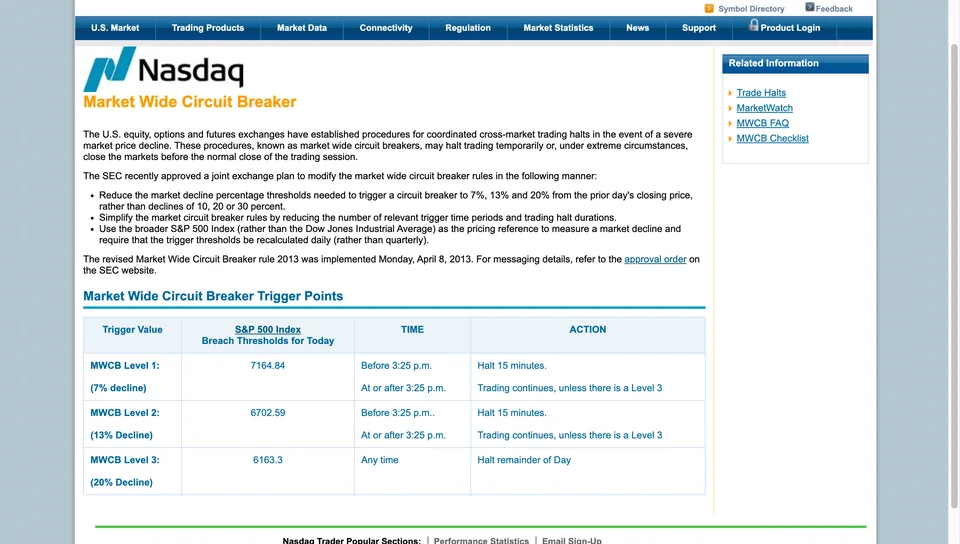
The index levels behind the three thresholds are recalculated every day from the S&P 500's prior close. The screenshot shows what the page listed on September 26, 2026 (a Saturday): Level 1 at 7164.84, Level 2 at 6702.59 and Level 3 at 6163.3. Work them backwards:
- Level 1: 7164.84 ÷ (1 − 7%) = 7164.84 ÷ 0.93 ≈ 7704.13
- Level 2: 6702.59 ÷ (1 − 13%) = 6702.59 ÷ 0.87 ≈ 7704.13
- Level 3: 6163.3 ÷ (1 − 20%) = 6163.3 ÷ 0.80 ≈ 7704.13
All three come back to roughly 7704.13, so that is the prior close the page was working from, even though it doesn't print it. It works the other way too: multiply any day's S&P 500 close by 0.93, 0.87 and 0.80 and you have the next trading day's three thresholds. To see how far the market can drop today before it stops, open that Nasdaq Trader page and look at the MWCB Level 1 row.
These rules took effect on April 8, 2013. Before that, circuit breakers were keyed to the Dow Jones Industrial Average, the thresholds were 10%, 20% and 30% declines, and the point levels were reset only once a quarter.
Why a single US stock suddenly stops trading for 5 minutes
The single-stock brake is Limit Up-Limit Down, or LULD; Investor.gov also calls it the single stock circuit breaker. The SEC approved it as a pilot on May 31, 2012, and made it permanent on April 11, 2019. It only runs in the regular session, 9:30 a.m. to 4:00 p.m. ET, so pre-market and after-hours trading fall outside it. Its job is to stop trades from printing outside a set price band.
How the LULD price band is set
The band is drawn around a reference price: the arithmetic mean of the stock's eligible trades over the previous five minutes. The day's first reference price is the primary listing exchange's opening price, or in some cases the previous close. If there were no eligible trades in the prior five minutes, the previous reference price stays in effect. The formula on the LULD Plan website is:
Price Band = Reference Price ± (Reference Price × Percentage Parameter), rounded to the nearest penny.
The percentage depends on two things: whether the stock is Tier 1 or Tier 2, and where it closed the day before. Tier 1 covers every stock in the S&P 500 and the Russell 1000 plus selected exchange-traded products (ETPs); Tier 2 is every other NMS stock, with rights and warrants left out. In the table below, low-priced Tier 2 means a Tier 2 stock whose previous close was $3.00 or less.
| Applies to | Previous close | Percentage |
|---|---|---|
| Tier 1 | Above $3.00 | 5% |
| Tier 1 and low-priced Tier 2 | $0.75 up to and including $3.00 | 20% |
| Tier 1 and low-priced Tier 2 | Below $0.75 | The lesser of $0.15 or 75% |
| Tier 2 | Above $3.00 | 10% |
In the last 25 minutes before the close (from 3:35 p.m. ET), the bands double for all Tier 1 securities and for Tier 2 securities at $3.00 or below. Tier 2 stocks above $3.00 stay at 10% all day.
The plan's own illustration uses a Tier 1 stock called XYZ with a previous close of $25, which puts it in the 5% bucket: 25 × 5% = 1.25, so the band runs from $23.75 to $26.25. The illustration stops there. Running the same reference price through the last 25 minutes yourself, the percentage doubles to 10%: 25 × 10% = 2.5, and the band widens to $22.50–$27.50.
What happens when the quote reaches the edge of the band
Bids and offers outside the band are flagged as unexecutable, so no trade can print outside it. Once the quote reaches the edge, things play out in this order:
- The national best offer sits on the lower band, or the national best bid sits on the upper band, without crossing it. The stock enters a Limit State.
- If every quote sitting at the edge is executed or canceled in full within 15 seconds, the Limit State ends and trading carries on as normal.
- If it hasn't ended after 15 seconds, the primary listing exchange declares a five-minute trading pause.
- The pause can be extended by another five minutes, after which all markets may resume trading.
- If the pause falls in the last 10 minutes of the regular session, the primary listing exchange does not reopen trading. It runs its closing procedure and tries to complete a closing transaction instead.
Investor.gov puts it more briefly: if the price moves to the band and doesn't come back inside it within 15 seconds, trading pauses for five minutes. So when your quote app shows a US stock's trades suddenly going quiet for a while and then starting up again, check how long the gap was. Five minutes, with at most another five on top, is the rhythm of an LULD pause.
What happens to your tokenized US stock when the real share is halted
Take xStocks. The token's secondary-market hours are separate from the exchange's open and close. The xStocks FAQ says the tokens are issued under the SPL Token-2022 or ERC-20 standard and can trade 24/7 on secondary markets like any other token, depending on the platform; issuance and redemption only happen on business days when the US market is open, normally 24/5. Secondary-market prices are set by supply and demand on each platform, and the issuer doesn't control them.
How the token is handled on secondary markets while the underlying share is stopped by a circuit breaker or an LULD pause isn't covered anywhere in the xStocks documentation. If it happens, go by the announcements of the platform you use.
Mechanically, whether the share is paused for 5 minutes or for the rest of the day, the token loses its live reference price from the real share. That puts it in much the same position as when the US market is closed, with the price set only by the orders resting on the platform. Why token spreads widen and prices gap during closed hours is covered in Binance stock trading hours: weekends and after hours; how to read the premium or discount when the token drifts away from the share is in why tokenized stock prices differ from the real share.
Circuit breaker and LULD stops last anywhere from a few minutes to the rest of the day. Longer suspensions, delistings and take-private deals are a different matter; for what holders end up getting back, see tokenized stock delisted? What holders get back.
How to place orders on tokenized stocks during a circuit breaker or a single-stock pause
While the real share is stopped, the number still ticking on the token's chart is, as I see it, just where a few orders on that platform happened to match. Don't read it as the share price. If you really have to act then, use a limit order and set the price at a level you can live with. A market order hitting a book with no share price behind it could fill anywhere, and nobody can tell you where before you send it. Waiting until the share resumes trading and the price has a reference again before you decide to add or sell puts you on much firmer ground. A limit order set on the wrong side of the market fills on the spot; that trap is covered in why a limit order fills immediately and what it costs.
US circuit breaker times in UTC+8 (Beijing, Hong Kong, Singapore)
Every time above is US Eastern Time. When New York is on daylight saving time it is 12 hours behind UTC+8; on standard time, 13 hours behind. In September 2026 New York is still on daylight saving time, so read the middle column:
| Eastern Time | UTC+8 (New York on daylight time) | UTC+8 (New York on standard time) |
|---|---|---|
| 9:30–16:00 regular session | 21:30 to 04:00 next day | 22:30 to 05:00 next day |
| 15:25 cutoff for Level 1 and Level 2 | 03:25 next day | 04:25 next day |
| 15:35 LULD bands start doubling | 03:35 next day | 04:35 next day |
| 15:50 onward, a paused stock does not reopen | 03:50 next day | 04:50 next day |
Common questions about US circuit breakers and trading halts
What is a stock market circuit breaker in the US?
It is a halt across the whole market, triggered by how far the S&P 500 has fallen from the prior day's close. A 7% drop is Level 1 and a 13% drop is Level 2; either one before 3:25 p.m. ET halts all trading for 15 minutes, while at or after 3:25 p.m. trading carries on. A 20% drop is Level 3 and halts trading for the rest of the day, whenever it happens. The single-stock layer is LULD, which Investor.gov also calls the single stock circuit breaker.
Are the circuit breaker levels the same every day?
No. The three thresholds are recalculated every day from the S&P 500's prior close, so the index levels move daily. On September 26, 2026, the Nasdaq Trader page showed 7164.84 for Level 1, 6702.59 for Level 2 and 6163.3 for Level 3. Before April 2013 the circuit breakers were keyed to the Dow Jones Industrial Average, and the levels were reset only once a quarter.
How long does a single-stock trading pause last?
An LULD pause lasts 5 minutes and can be extended by another 5, after which all markets may resume trading. If the pause falls in the last 10 minutes of the regular session, the primary listing exchange does not reopen trading and runs its closing procedure instead. LULD covers only the regular session, 9:30 a.m. to 4:00 p.m. ET.
Can I still trade tokenized stocks while the real share is halted?
Taking xStocks as the example, its documentation says the tokens can trade 24/7 on secondary markets, depending on the platform, while issuance and redemption only happen on business days when the US market is open. The documentation does not say how secondary markets handle a circuit breaker or an LULD pause on the underlying share, so check your platform's announcements when it happens, and use limit orders.
Read next: Binance stock trading hours: weekends and after hours · Why tokenized stock prices differ from the real share · Tokenized stock delisted? What holders get back · Tokenized stock meaning: real share or just a token?